Why choose Cycle Hoops?
What is a Cycle Hoop?
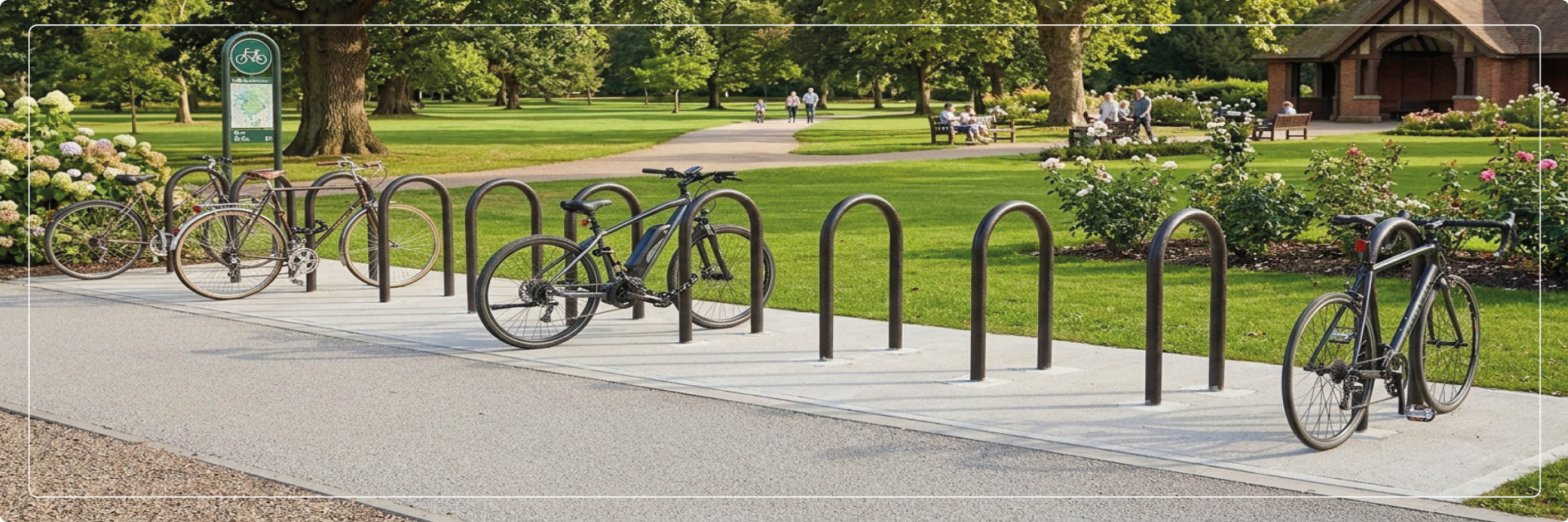
A cycle hoop, also called a bicycle stand, cycle stand, or Sheffield stand, is an inverted-U steel tube fixed to the ground so that a bike can be locked to it by the frame and wheel. Each hoop typically parks two bicycles, one either side, which makes it one of the most space-efficient forms of cycle parking available.
The design is deliberately simple. There are no moving parts, nothing to service and nothing to break, which is why hoops are the default choice for schools, offices, retail parks, residential developments, transport hubs and public realm schemes. Hoops from F.H.Brundle are available as bolt-down (surface-mounted) or concrete-in (root-fixed) versions, in a galvanised or black powder-coated finish.
What are the choices when it comes to Cycle Hoops?
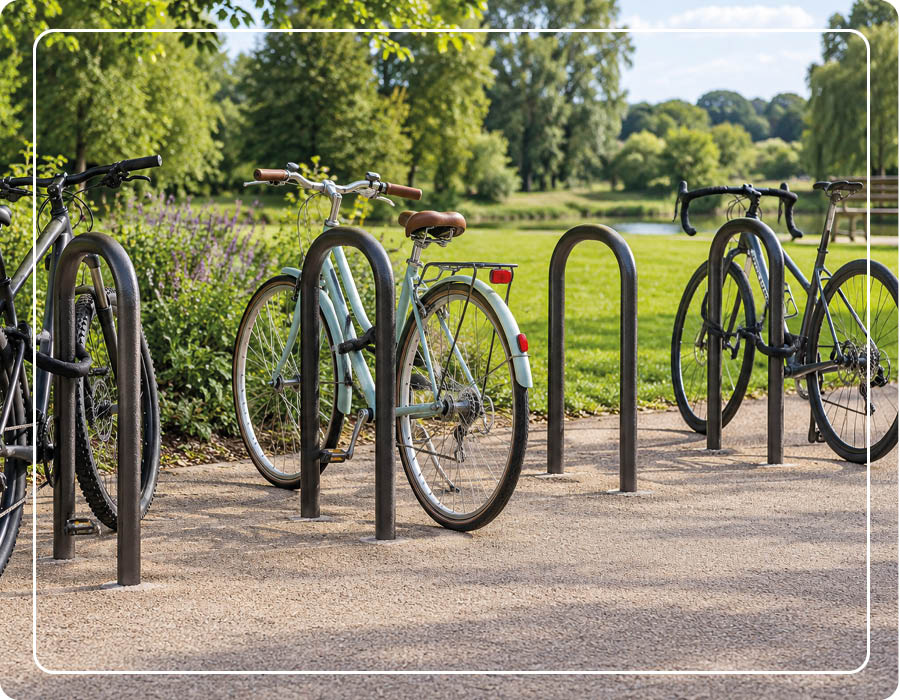
At F.H.Brundle, we offer a selection of cycle hoops designed to suit both new-build and retrofit projects. The right choice depends on three things: the ground you are fixing into, the level of security the site needs, and the finish the specification calls for. The tables below compare the main options side by side.
| Feature Category | Key Benefit | Detail |
|---|---|---|
| Security | Locks frame and wheel |
The inverted-U shape lets users lock the frame and at least one wheel with a D-lock or chain, which is the arrangement most insurers and security advisers recommend. |
| Capacity | Two bikes per hoop |
One bike can be parked on each side, so a single hoop delivers two cycle spaces in a small footprint. |
| Durability | Built to last |
Tubular steel is strong, difficult to cut with hand tools and, when galvanised or coated, resists corrosion for many years outdoors. |
| Low maintenance | No servicing | With no moving parts, a hoop needs only the occasional wash and a check on its fixings. |
| Flexibility | Fits most sites |
Available for fixing into concrete, paving, tarmac or soft ground, singly or in multiple-hoop runs. |
| Accessibility | Easy for users |
A simple, open shape is easy to use for a wide range of cycles, including many cargo bikes and adapted cycles. |
Comparing fixing methods
| Bolt-down (surface-mounted) | Concrete-in (root-fixed) | |
|---|---|---|
| How it is fixed |
Base plates are bolted to an existing hard surface using anchors or shear-nut bolts |
Legs are set into a concrete foundation below ground level |
| Best suited to |
Existing concrete slabs, paving or tarmac |
New-build groundworks, soft ground and landscaped areas |
| Installation speed |
Quickest; no excavation needed |
Slower; needs excavation and curing time |
| Security level | Good, particularly with tamper-resistant fixings | Highest; nothing to unbolt or tamper with |
| Removable later |
Yes, if the site layout changes |
No, unless cut out and the foundation made good |
| Installer tip |
Check the substrate is thick enough and sound before drilling |
Allow the concrete to cure fully before use |
| Specifier tip |
Specify fixings and tamper-resistant fittings explicitly |
Specify foundation depth and concrete grade to the manufacturer’s guidance |
Comparing finishes
| Hot-Dip Galvanised | Hot-Dip Galvanised & Powder-Coated | |
|---|---|---|
| Appearance | Silver-grey, industrial | Black |
| Corrosion resistance | Very good for general outdoor use |
Excellent; coating adds a second layer of protection |
| Relative cost | Lowest | Medium |
| Maintenance | Minimal |
Minimal; touch up chips to protect the steel beneath |
| Best for |
Schools, car parks, general commercial use |
Developments, offices and public realm where colour matching matters |
“Simple, secure and low-maintenance qualities are driving the popularity of cycle hoops”
As cycling investment grows, developers, local authorities and employers are turning to steel cycle hoops because they combine security with simplicity. A galvanised or powder-coated steel hoop offers dependable, long-term cycle parking with very little upkeep, which keeps whole-life costs down for the eventual site owner.
Where can Cycle Hoops be used?
Cycle hoops suit almost any location where people arrive by bike. Their small footprint and simple fixing mean they can be installed on both large developments and small retrofit projects.
Common applications include:
• Residential developments: apartment blocks, new-build estates and housing association schemes, where planning conditions often require secure cycle parking
• Commercial and office premises: staff and visitor parking, often alongside showers and lockers
• Education: schools, colleges and universities with high daily demand
• Retail and leisure: retail parks, supermarkets, gyms, parks and visitor attractions
• Public realm and transport: streets, town centres, stations and bus interchanges
• Healthcare and public buildings: hospitals, surgeries, libraries and council offices
Hoops are supplied ready to fit, so a team can usually install a run of stands in a single visit. Bolt-down versions go in quickly over existing hard surfaces, while concrete-in versions suit fresh groundworks where you are already pouring foundations. Neither requires welding or specialist skills on site.
Why are Cycle Hoops becoming more popular?
Cycle hoops are growing in popularity because they offer three clear benefits to everyone involved in a project.
(1) Simplicity: a hoop has no moving parts, so there is almost nothing to install incorrectly and nothing to maintain. It is a proven design that users understand instantly.
(2) Durability: hot-dip galvanising gives steel hoops long-term corrosion protection, and a powder-coated finish adds colour and a second layer of defence. Stainless options are available where appearance is the priority.
(3) Cost efficiency: hoops use a small amount of material to create two secure cycle spaces, and low installation and maintenance costs mean a low whole-life cost. Ordering from a single supplier alongside fixings, anchors and coatings also keeps procurement simple.
With more people cycling to work, school and the shops, and with planning policy increasingly asking developers to provide secure cycle parking, demand for dependable hoops continues to rise.
How to order
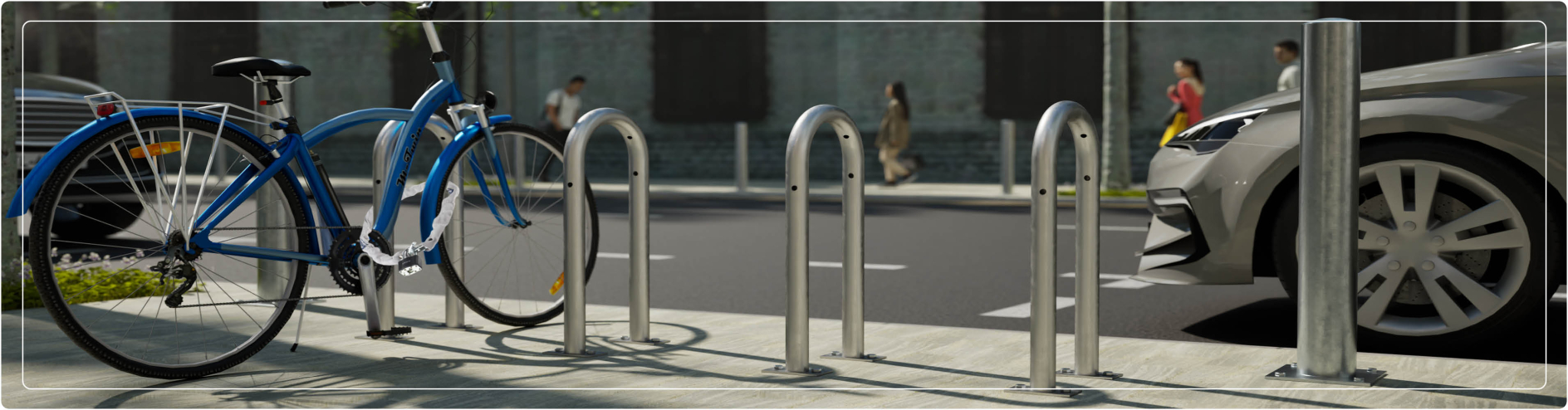
Now you have more insight into the benefits and uses of cycle hoops, here is how to choose and order the right ones.
1. Measure and plan
2. Select a fixing type
3. Choose your material and finish
4. Order with confidence
(1) Measure and plan. Start by working out how many cycle spaces you need and where they will go. Remember that each hoop provides two spaces. Allow enough room around each hoop so bikes can be parked and removed easily; guidance commonly recommends around 1 metre between hoops and clear space from walls and kerbs [CONFIRM against current local authority guidance or LTN 1/20 for your project]. Keep hoops clear of pedestrian routes, doorways and escape routes.
(2) Select a fixing type. Check the surface you are fixing into. Existing concrete, paving or tarmac suits bolt-down hoops, which can be fitted quickly with the correct anchors. Soft ground or new groundworks suit concrete-in hoops, which offer the highest security. Our Anchors & Bolts and Concrete Screws & Bolts ranges can supply suitable fixings.
(3) Choose your material and finish. Hot-dip galvanised steel is the practical, cost-effective choice for most sites. Powder-coated hoops in black suit developments with a defined colour scheme.
(4) Order with confidence. Orders over £150 ex VAT qualify for free expedited delivery to mainland UK. Our team can help with quantities and compatible fixings, and you can request our catalogue or samples to check the finish before you commit. With branches in Rainham, Glasgow, Birmingham, Southampton, Ilkeston, Newton, Newport and Burton, help is never far away.
FAQs
A cycle hoop is an inverted-U steel stand that a bike can be locked to by its frame and wheel. It is also called a bicycle stand, cycle stand, or Sheffield stand, and each hoop typically parks two bikes.
One hoop normally holds two bikes, one on each side. If your project needs 20 cycle spaces, you will need 10 hoops, plus enough room between them for bikes to be parked comfortably.
Yes, bolt-down hoops are designed for this. The surface must be sound and thick enough to hold the anchors, and tamper-resistant fixings are recommended for public locations. If the surface is thin or unstable, a concrete-in hoop may be a better choice.
Guidance commonly recommends around 1 metre between hoops, with additional clearance from walls, kerbs, and walkways. Requirements vary by project, so check your planning conditions and local authority guidance.
Yes, when installed correctly and used with a good quality D-lock. Steel tube resists cutting, and concrete-in fixing or tamper-resistant bolts make the hoop itself very hard to remove. Locking the frame and wheel to the hoop gives the best protection.