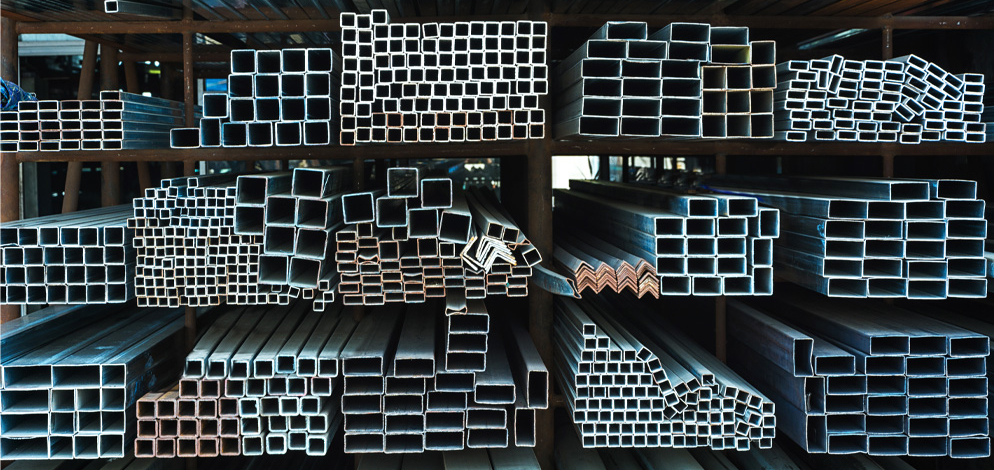
Given its composition, mild steel (all grades) is highly susceptible to oxidisation and corrosion, so how can you prevent it from rusting?
Unlike stainless steel, mild steel contains very little chromium, which means it has no natural barrier against moisture and oxygen. When bare mild steel is exposed to the elements, iron oxide forms rapidly on the surface. Left untreated, that surface rust penetrates deeper into the material, weakening its structural integrity and shortening its service life significantly.
The good news is that mild steel is straightforward to protect, and there are several proven methods available depending on your application, budget, and environment. The key principle across all of them is the same: seal the steel from moisture before moisture reaches it.
The most important rule in corrosion protection: preparation determines performance. Even the best coating system will fail prematurely if applied to a contaminated, scaled, or damp surface.
Surface preparation
No corrosion protection system performs better than the preparation beneath it. Before applying any coating, the steel surface must be clean, dry, and free from mill scale, rust, grease, and contamination. Skipping or rushing this step is the single most common reason protective coatings fail early.
Why mill scale is a problem
Hot-rolled mild steel sections leave the mill with a layer of mill scale: a dark, brittle iron oxide crust formed during the rolling process. Mill scale is denser than the steel beneath it and initially appears protective, but it is electrochemically different from the base metal. Over time it cracks, lifts, and creates the ideal conditions for accelerated corrosion beneath any coating applied over it.
For best results, mill scale should be removed before coating. The method you choose depends on the scale of the job and the finish required.
Mechanical preparation
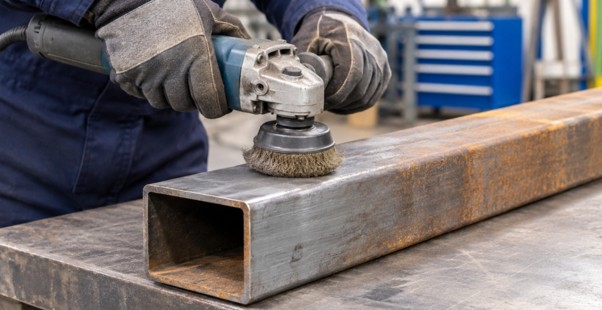
- Wire brushing and grinding remove loose rust and scale on smaller sections or repair work. Suitable for light-duty applications where a perfect surface finish is not critical.
- Shot blasting or grit blasting is the professional standard for structural steelwork and fabricated assemblies. It removes mill scale, rust, and contamination to a near-white metal finish (Sa 2.5 per ISO 8501-1), which maximises coating adhesion and longevity.
Chemical preparation solutions
Chemical treatments offer an effective alternative or complement to mechanical methods, particularly for complex shapes, hollow sections, or situations where blasting equipment is impractical.
- Degreasing solutions remove oils, cutting fluids, and handling contamination before any further treatment. Solvent-based or water-based degreasers are applied by wipe, spray, or immersion and should always be the first step.
- Phosphating treatments convert the steel surface into a layer of iron or zinc phosphate crystals, which improves paint adhesion and provides a degree of corrosion inhibition in its own right. Phosphating is widely used as a pre-treatment before powder coating and wet paint systems.
- Rust converters react chemically with existing iron oxide, converting it into a stable compound (typically iron tannate) that can be painted over. These are useful for maintenance and repair situations where complete rust removal is not practical, but they are not a substitute for proper mechanical preparation on new fabrications.
- Acid pickling uses a dilute acid solution (typically hydrochloric or sulphuric acid) to dissolve mill scale and rust. It produces a uniformly clean, reactive surface ideal for painting or galvanising. Pickling is most commonly carried out by specialist processors rather than on-site.
| Preparation Method | Best Used For | Typical Application |
|---|---|---|
| Wire brushing/grinding | Maintenance, light fabrication | On-site, hand tools |
| Shot/grit blasting | Structural steelwork, large fabrications | Workshop or specialist contractor |
| Degreasing | All steel before any coating | First step, always |
| Phosphating | Pre-treatment before paint or powder coat | Workshop chemical process |
| Rust converter | Repair and maintenance of existing rust | Workshop chemical process |
| Acid pickling | Pre-treatment before galvanising or painting | Specialist processor |
Red Oxide Paint
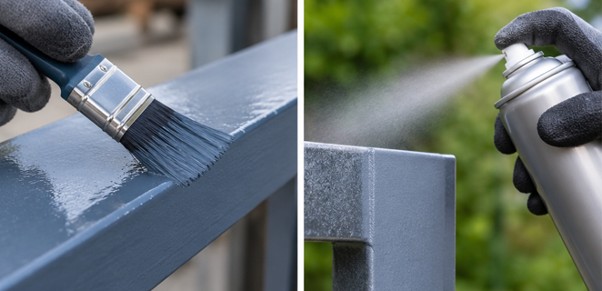
Red oxide paint is one of the most widely used and recognised corrosion inhibitors for mild steel, and for good reason. It has been a staple of the fabrication and construction industries for generations, offering reliable protection that is easy to apply with standard brush, roller, or spray equipment.
How red oxide works
The distinctive red-brown colour comes from iron oxide pigments (typically iron(III) oxide) suspended in an oil or alkyd resin binder. These pigments are chemically stable and act as a barrier, inhibiting the electrochemical reactions that cause rust to form. Some formulations also include additional anti-corrosive pigments such as zinc phosphate, which actively passivates the steel surface beneath the coating.
Red oxide is a primer, not a topcoat. It is designed to be the first coat applied to bare or prepared steel, providing adhesion for subsequent topcoat layers. Applying it without a topcoat will offer short-term protection, but the coating will weather and degrade, particularly in exposed outdoor environments.
When to use red oxide paint
Red oxide primer is particularly well suited to:
- Fabricated steelwork for gates, railings, frames, and fencing
- Structural sections used in sheltered or semi-exposed environments
- On-site application where powder coating is not practical
- Repair and maintenance of existing painted steelwork
- Projects where a brush-applied system is preferred over a specialist coating process
Application guidance
- Ensure the surface is clean, dry, and free from loose rust, scale, and grease before application.
- Apply by brush, roller, or spray in a single even coat, typically 50 to 75 microns dry film thickness.
- Allow to cure fully before applying a compatible topcoat (check the manufacturer’s recoat window).
- Finish with a suitable metal topcoat paint in the desired colour and sheen level.
Tip: For external applications, always use a topcoat rated for exterior use over the red oxide primer. The primer handles adhesion and corrosion inhibition; the topcoat handles UV resistance, weathering, and appearance.
Primers and Specialist Paints
Beyond red oxide, there is a broad range of primers and specialist paint systems designed for mild steel, each suited to different environments and performance requirements. Choosing the right system depends on the exposure conditions, the substrate condition, and the level of corrosion protection needed.
Zinc phosphate primers
Zinc phosphate primers are among the most widely specified primers for structural and fabricated steelwork. They contain zinc phosphate as the active anti-corrosive pigment, which passivates the steel surface and inhibits the spread of rust. Zinc phosphate primers offer better corrosion resistance than basic red oxide formulations and are compatible with a wide range of topcoats.
They are commonly used on:
- Gates, railings, and fencing exposed to outdoor conditions
- Structural steel in construction and civil engineering
- Agricultural and industrial equipment
Epoxy primers
Two-pack epoxy primers provide a hard, chemically resistant film that bonds strongly to prepared steel. They are particularly effective in demanding environments, including chemical exposure, high humidity, and immersion conditions. Epoxy primers are the preferred choice where a high-build, long-life system is required.
Key characteristics of epoxy primers:
- Excellent adhesion to grit-blasted or phosphated steel
- High resistance to moisture, chemicals, and abrasion
- Typically used as part of a two or three-coat system with an epoxy or polyurethane topcoat
- Longer cure times than single-pack systems; requires careful surface preparation
Etch primers
Etch primers (also called wash primers or acid etch primers) contain phosphoric acid, which reacts with the steel surface to promote adhesion. They are thin-film products applied in a single coat and are particularly useful on lightly prepared or smooth surfaces where mechanical keying is limited.
Etch primers are commonly used as a first coat on bright steel, cold-rolled sections, and aluminium before a conventional primer and topcoat system.
Specialist topcoat paints
Once a primer is applied, the topcoat provides the final layer of protection and determines the appearance and long-term weathering performance. Common topcoat types for mild steel include:
| Topcoat Type | Characteristics | Typical Use |
|---|---|---|
| Alkyd (oil-based) | Good durability, easy to apply, slower drying | General steelwork, gates, railings |
| Chlorinated rubber | Fast drying, good moisture resistance | Marine and industrial environments |
| Polyurethane (PU) | Excellent UV resistance and gloss retention | Architectural steelwork, high-visibility finishes |
| Two-pack epoxy | Highest chemical and abrasion resistance | Industrial plant, aggressive environments |
| Bituminous paint | Waterproof, low cost | Underground, buried, or immersed steelwork |
For most fabricated mild steel in construction, fencing, and gate applications, a zinc phosphate primer followed by a polyurethane or alkyd topcoat provides a practical and durable solution.
Polyester Powder Coating
Polyester powder coating is the most durable and aesthetically consistent finish available for mild steel fabrications. It is the coating of choice for gates, railings, balustrades, fencing panels, and architectural steelwork where long-term appearance and corrosion resistance both matter.
How powder coating works
Unlike liquid paints, powder coating is applied as a dry, electrostatically charged powder that adheres to the grounded steel workpiece. The coated part is then passed through a curing oven, typically at temperatures between 160°C and 200°C, where the powder melts, flows, and cross-links into a hard, continuous film.
The result is a uniform, tough coating that is significantly thicker and more impact-resistant than most brush-applied paint systems, typically 60 to 120 microns dry film thickness in a single coat.
Why polyester powder coating for mild steel?
Polyester is the most commonly specified resin system for architectural and external applications because it offers an excellent balance of:
- UV resistance: Polyester retains colour and gloss far better than epoxy-based powder coatings, which can chalk and fade in sunlight.
- Weather resistance: Performs well across a wide range of temperatures and humidity levels, including the UK’s variable outdoor conditions.
- Colour choice: Available in any RAL or BS colour, including textured, satin, and gloss finishes, giving fabricators precise control over the final appearance.
- Durability: The cured film resists chipping, scratching, and abrasion better than most wet paint systems.
Limitations to be aware of
Powder coating is not impervious. If the coating is chipped or damaged, bare mild steel is exposed and will rust at the point of damage. This is particularly relevant for gate hardware, hinges, and areas subject to mechanical impact.
Two practical measures reduce this risk:
- Pre-treatment before powder coating. Shot blasting to Sa 2.5 followed by iron or zinc phosphating before the powder is applied maximises adhesion and provides a secondary barrier if the topcoat is breached.
- Prompt repair of damage. Small chips should be treated with a compatible touch-up paint or cold galvanising compound as soon as they are identified, before moisture reaches the steel beneath.
Powder coating vs. wet paint: which is right for your project?
| Factor | Powder Coating | Wet Paint System |
|---|---|---|
| Application method | Specialist workshop process | On-site or workshop |
| Finish consistency | Highly uniform | Variable, skill-dependent |
| Film thickness | 60 to 120 microns in one coat | Multiple coats required for equivalent build |
| UV resistance | Excellent (polyester) | Good to excellent (PU topcoat) |
| Colour range | Full RAL / BS range | Full RAL / BS range |
| Repair on-site | Difficult; requires specialist equipment | Straightforward |
| Cost | Higher unit cost; no labour for multiple coats | Lower material cost; higher labour input |
| Best for | Fabricated components finished in a workshop | On-site application, large structural sections |
For fabricated gates, railings, and fencing panels produced in a workshop environment, polyester powder coating almost always delivers a better long-term result than a brush-applied paint system. For large structural sections or on-site work, a high-quality wet paint system remains the practical choice.
Other Corrosion Protection Methods
Paint and powder coating are the most common protection routes for fabricated mild steel, but several other methods are worth understanding, particularly for structural applications or environments where standard coatings have limitations.
Hot-dip galvanising
Hot-dip galvanising involves immersing the fabricated steel in a bath of molten zinc at approximately 450°C. The zinc bonds metallurgically with the steel surface, forming a series of zinc-iron alloy layers topped with a pure zinc outer layer.
The result is a coating that protects mild steel in two ways: as a physical barrier and through cathodic protection, meaning the zinc sacrifices itself to protect the steel if the coating is scratched or damaged. Hot-dip galvanised mild steel is widely used in:
- Agricultural fencing and field gates
- Highway safety barriers and structural components
- External frameworks, brackets, and fixings in exposed environments
Important note: Welding and machining after galvanising will damage the coating and must be repaired with cold galvanising compound or zinc-rich paint.
Cold galvanising (zinc-rich paint)
Cold galvanising compounds are zinc-rich paints applied by brush or spray that provide a similar cathodic protection mechanism to hot-dip galvanising, though with lower zinc content and less durability. They are widely used for:
- Touch-up and repair of damaged galvanised coatings
- Treating welds and cut edges on galvanised sections
- On-site protection where hot-dip galvanising is not practical
Wax and oil treatments
Penetrating wax and oil-based treatments are used primarily for temporary protection during storage and transit, or for decorative wrought iron and mild steel features in sheltered environments. They do not provide long-term outdoor protection but are effective for:
- Workshop storage of uncoated steel sections
- Decorative indoor ironwork and furniture
- Maintenance of existing metalwork in dry or semi-sheltered conditions
Choosing the right protection method
The right approach depends on three factors: environment, application, and budget.
- Indoor or sheltered use: A single coat of red oxide primer or a wax treatment may be sufficient.
- External domestic use (gates, railings, fencing): Polyester powder coating or a zinc phosphate primer with PU topcoat is the practical standard.
- Aggressive outdoor or coastal environments: Hot-dip galvanising, or a duplex system (galvanising plus powder coating), offers the highest level of protection.
- Structural steelwork: Consult the relevant specification; BS EN ISO 12944 provides the industry standard for corrosion protection of steel structures by protective paint systems.
Corrosion Protection: Quick Reference Summary
| Protection Method | How It Works | Best Environment | DIY/On-Site | Typical LIfespan | Relative Cost |
|---|---|---|---|---|---|
| Red oxide primer + topcoat | Barrier and inhibitor pigments | General outdoor use | Yes | 5 to 10 years with maintenance | ££ |
| Zinc phosphate primer + topcoat | Active passivation + barrier | Outdoor, exposed | Yes | 8 to 15 years | ££ |
| Epoxy primer + PU topcoat | High-build barrier system | Demanding environments | Specialist recommended | 10 to 20 years | £££ |
| Polyester powder coating | Tough electrostatic film | Architectural, external | Workshop process | 15 to 25 years | £££ |
| Hot-dip galvanising | Metallurgical zinc bond + cathodic protection | Aggressive outdoor, coastal | Specialist processor | 25 to 70 years | ££££ |
| Duplex (galvanising + powder coat) | Combined barrier and cathodic protection | Coastal, industrial | Workshop process | 40+ years | ££££ |
| Cold galvanising compound | Zinc-rich paint, cathodic action | Repair and maintenance | Yes | 5 to 10 years | £ |
| Wax/oil treatment | Temporary moisture barrier | Indoor/sheltered only | Yes | 1 to 3 years | £ |
Lifespan figures are indicative and depend on surface preparation quality, coating thickness, environment, and maintenance. Proper preparation consistently has the greatest influence on how long any protection system lasts.
For advice on the right mild steel sections for your project, or to discuss corrosion protection options, contact the F.H.Brundle team or view the full range of steel sections.