If you’ve ever stood in front of a project spec and wondered whether to go stainless or galvanised, you’re not alone. It’s one of the most common questions we hear from fabricators, contractors and DIY builders alike, and the answer isn’t always obvious from the product names alone.
Both materials start life as steel. What makes them different is what happens next: how they’re protected, how long that protection lasts, and which environments they’re suited to. Get it right and you’ll have a finish that performs for decades. Get it wrong and you’re looking at premature corrosion, costly replacements or a material that simply doesn’t suit the application.
The short answer: use stainless steel for exposed, wet, coastal or design-led work. Use galvanised steel for robust, cost-effective structural and outdoor applications where appearance is secondary to performance.
This guide covers everything you need to make the right call, including a full side-by-side comparison, answers to the questions buyers most commonly ask, and guidance on where each material genuinely excels.
TL;DR
• Stainless steel costs more upfront but lasts 50+ years with minimal maintenance. Essential for coastal, wet, poolside or design-led applications. Aim to use grade 316 externally – 304 can be used externally, but isn’t recommended, Definitely avoid using 304 if the installation is within a few miles of the coast.
• Galvanised steel is the cost-effective choice for structural, agricultural and general outdoor work where appearance is secondary. Lifespan of 20-40 years in typical UK conditions.
• Never use galvanised steel near the coast as a long-term solution. Salt air depletes the zinc coating significantly faster than inland environments.
• Mixing the two is possible but requires isolating washers or sealant at contact points to prevent galvanic corrosion.
• When in doubt, go stainless. The cost of replacing the wrong material almost always exceeds the upgrade cost at the point of specification.
What Is the Difference Between Stainless Steel and Galvanised Steel?
The difference comes down to how each material resists corrosion, and the chemistry behind each method is fundamentally different.
Stainless steel is an alloy. Chromium (typically 10.5% or more by mass) is added during the steelmaking process itself, forming a thin, self-repairing oxide layer on the surface. This passive layer is what gives stainless steel its corrosion resistance, and because it’s part of the material rather than a coating applied afterwards, it cannot peel, chip or wear away in the same way a surface treatment can. The British Stainless Steel Association defines this chromium oxide layer as the key to the material’s durability in demanding environments.
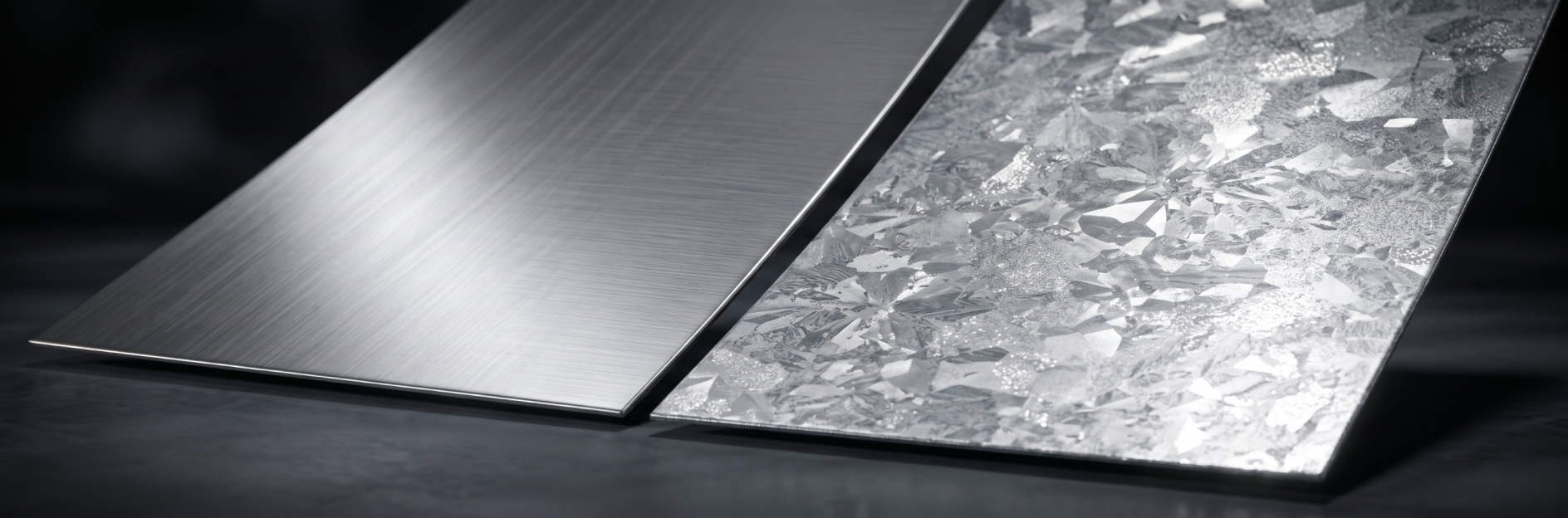
Galvanised steel is mild steel that has been coated with a layer of zinc, most commonly through a process called hot-dip galvanising. The steel is submerged in a bath of molten zinc at around 450°C, which creates a metallurgical bond between the zinc and the steel surface. The zinc acts as a sacrificial barrier: it corrodes preferentially, protecting the steel underneath. Even if the surface is scratched or damaged, the zinc around the affected area continues to offer cathodic protection.
The key distinction
• Stainless steel’s protection is intrinsic to the material
• Galvanised steel’s protection is a coating applied to the surface
This distinction matters enormously in practice. Stainless steel can be cut, welded and fabricated without compromising its corrosion resistance (provided the correct grade and welding technique are used – view our range of low-carbon stainless steel sections). Galvanised steel that is cut or welded will have exposed bare steel at the cut edge, which requires re-treatment to maintain full protection.
Stainless Steel vs Galvanised Steel: Side-by-Side Comparison
| Property | Stainless Steel | Galvanised Steel |
|---|---|---|
| Corrosion resistance | Excellent; self-repairing passive layer | Good; zinc sacrificial coating |
| Expected lifespan | 50+ years with minimal maintenance | 20-70 years depending on coating thickness and environment |
| Initial cost | Higher, typically 3-5 times the cost of galvanised steel | Lower; cost-effective for structural work |
| Maintenance | Very low; occasional cleaning only | Low, but cut edges and welds need re-treatment |
| Coastal suitability | Grade 316 recommended within 1km of the sea | Not recommended in marine or highly saline environments |
| Appearance | Bright, polished or brushed finish; suitable for visible, design-led work | Spangled or matte grey; functional rather than decorative |
| Fabrication | Can be cut and welded; grade and technique matter | Cut edges expose bare steel; re-galvanising or cold galvanising spray needed |
| Weight | Slightly heavier than equivalent galvanised sections | Standard |
| Recyclability | Fully recyclable | Fully recyclable |
| Typical applications | Handrails, balustrades, marine hardware, food-grade environments and architectural features | Structural steelwork, fencing, gates, agricultural buildings and general outdoor construction |
Which Grade of Stainless Steel Should You Use?
Not all stainless steel is equal, and grade selection is one of the most common points of confusion for buyers.
Grade 304 (1.4301)
Grade 304 is the most widely used stainless steel grade. It contains roughly 18% chromium and 8% nickel, giving it good general corrosion resistance in most indoor and sheltered outdoor environments. It’s the standard choice for:
• Interior handrails and balustrades
• Kitchen and food preparation equipment
• Architectural features in urban or suburban environments
• General fabrication where the material won’t be exposed to chlorides
Grade 316 (1.4401)
Grade 316 adds molybdenum to the alloy, which significantly improves resistance to chloride-induced corrosion (the kind caused by salt water and de-icing salts). If your project is within approximately 3km of the coastline, or involves regular exposure to salt, chlorine or aggressive chemicals, 316 is the correct choice. It’s also the standard for:
• Marine and coastal handrails, balustrades and fixtures
• Swimming pool environments
• Outdoor furniture and architectural features in exposed locations
• Industrial applications involving chemicals or saline solutions
The practical rule: if in doubt between 304 and 316 for an outdoor application in the UK, 316 is the safer choice. The cost difference is modest and the performance difference in exposed conditions is significant.
Which Material Is Right for Your Project?
Use this as a quick reference before specifying:
Choose stainless steel (grade 304) when:
• The installation is indoors or in a sheltered, low-humidity environment
• Appearance matters and a clean, polished finish is required
• The component will be touched regularly (handrails, balustrades, grab rails)
• You need a food-safe or hygiene-critical material
• Long-term, low-maintenance performance is the priority
Choose stainless steel (grade 316) when:
• The project is coastal, marine or poolside
• The component will be exposed to salt, chlorine or industrial chemicals
• You’re specifying for a high-end architectural or design-led scheme
• The installation is permanent and replacement would be disruptive or costly
Choose galvanised steel when:
• The application is structural rather than decorative
• The project is inland and not exposed to aggressive environmental conditions
• Budget is a primary constraint and the component won’t be highly visible
• The steel will be painted over (galvanised steel takes paint well after correct preparation)
• You’re working on agricultural buildings, general fencing, gates or temporary structures
Shop Stainless and Galvanised Steel at F.H. Brundle
We stock an extensive range of both stainless and galvanised steel products, with over 13,000 stock lines available for nationwide delivery or click-and-collect from branches across the UK.
Whether you’re specifying a stainless steel handrail system for a coastal development, sourcing galvanised fencing posts for an agricultural project, or fabricating a bespoke gate, our team can help you select the right material and grade for your application.
• Stainless Steel Handrail Systems – Grade 304 and 316 components, including tube, fittings and complete system kits
• Fencing and Security – Galvanised fencing posts, panels, mesh systems and estate fencing
• Gates and Gate Hardware – Galvanised and powder-coated gate options for residential and commercial applications
Free delivery on mainland UK orders over £150 ex VAT. Trade credit accounts available for approved customers.
Don’t forget to check out our range of fabrication materials, from mild steel, galvanised profiles, stainless steel sections and even GRP profiles.