Why Choose GRP Stair Treads & Nosing?
What are GRP stair treads
& nosing?
Glass Reinforced Plastic (GRP) stair treads, and nosing, sometimes referred to as glass fibre nosing, are safety-focused flooring components made from high-quality fibreglass and resin. They are designed to provide a highly durable, slip-resistant surface for steps in residential, commercial, and industrial settings.
GRP stair treads are an extremely strong, one-piece open mesh panel that provides excellent compressive and tensile strength.
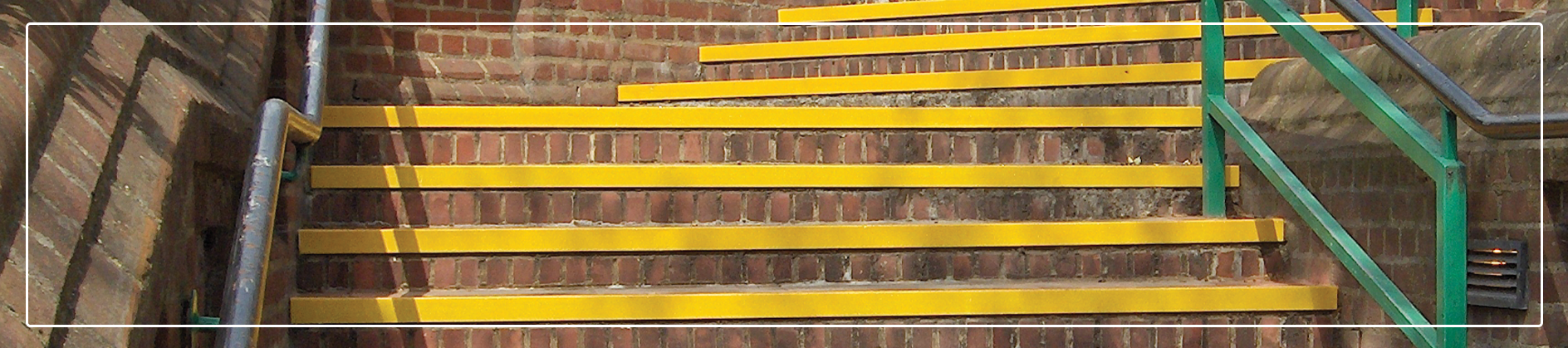
GRP nosing is the critical front edge of the stair tread, featuring an integrated, contrasting coloured gritted nosing.
What are the choices when it comes to GRP stair treads & nosing?
At F.H.Brundle, we offer a selection of GRP stair treads & nosing. Stair treads are available in green or grey with yellow gritted nosing, and yellow with black gritted nosing. Our range is available in 996 x 275mm and 1220 x 275mm tread size. Nosing are available in two grit profiles, Type I with a smaller fine grit size, usually for internal use and Type E with heavier coarse grit profile, for the rigours of the external environment.
| Feature Category | Key Benefit | Detail |
|---|---|---|
| Material Composition | High strength-to-weight ratio and environmental resilience | Manufactured from high-quality fibreglass and resin. It is much lighter than steel, fire and chemical resistant, and engineered to withstand major impacts and harsh weather. |
| Slip-Resistant Surface | Significantly improves public safety by reducing slips, trips, and falls | Nosing features a tough, embedded gritted top surface. Available in two grit profiles: Type I (Fine Grit) with a smaller grit size intended for internal use, and Type E (Coarse Grit) with a heavier profile designed for rigorous external environments. |
| Contrasting Nosing | Provides visual boundary highlighting for high accessibility. | Designed to contrast the leading edges of a staircase. Ideal for public-facing stairs to assist partially sighted users and ensure visibility in low lighting or poor weather. |
| Installation & Substrates | Fast, convenient, and cost-effective retrofitting. | Can be quickly applied over almost any existing structural surface, including concrete, steel, or timber, without replacing the underlying stair structure. |
| Size & Profile Options | Adaptable to specific building requirements and layout standards. | Nosing profiles are available in two primary sizes: 70 x 30mm and 55 x 55mm. |
| Corrosion Resistance | Low maintenance and long service life. | Completely rust and rot-proof, removing the need for frequent ongoing maintenance, periodic painting, or chemical protective treatments. |
Where can GRP stair treads & nosing be used?
GRP (Glass Reinforced Plastic) stair treads & nosing are incredibly versatile safety products. Because they are lightweight, impact-resistant, corrosion-resistant, and offer superior slip resistance, they can be used across a broad range of sectors, specific environments, and structural surfaces.
• Industrial & Manufacturing
• Highly Corrosive & Wet Environments
• Public Infrastructure & Transport
• Indoor Use
• Outdoor Use
Why are GRP stair treads & nosing so popular?
GRP (Glass Reinforced Plastic) stair treads & nosing are highly popular because they offer a cost-effective, high-performance solution to critical safety and structural issues.
(1) Exceptional Slip Resistance and Public Safety: The tough, embedded gritted surface of the nosing delivers maximum traction, and the ability to drastically reduce slips, trips, and falls. Two grit profiles to suit specific environments – Type I (Fine Grit) for internal use, and Type E (Coarse Grit) for external use.
(2) Instant Regulatory and Legal Compliance: For commercial property owners, public infrastructure managers, and employers, these products offer an immediate way to meet strict legal safety standards. The integrated, contrasting-coloured nosing makes the edge of each step highly visible.
(3) Cost-Effective and Easy Installation: Instead of closing a staircase and paying for a full, structural replacement, GRP allows for easy rejuvenation. Treads and nosings are designed to fit quickly and directly over almost any existing surface, including concrete, steel, or timber.
(4) Extreme Material Durability and Zero Upkeep: GRP outlasts traditional materials like wood or steel in harsh conditions while requiring virtually no maintenance. They are completely rust-proof, rot-proof, chemical-resistant, and fire-retardant. While they are incredibly lightweight they are engineered to withstand major impacts and heavy, high-traffic environmental strains.
Technical Standards & Compliance
At F.H.Brundle, quality and safety are paramount. Our GRP stair treads & nosing are manufactured to the highest industry standards to ensure your project meets the required levels of compliance:
• EN 13706: Complies with European standards for pultruded structural profiles.
• Grade E23: High-performance grade for load-bearing applications (wall thickness >5mm).
• Grade E17: Standard performance grade (wall thickness 3-5mm).
• Fire Retardancy: Available in grades that meet BS 476 Part 7 Class 1 or 2 (flame retardant) and low-smoke toxicity requirements.
GRP in Challenging Environments
Glass Reinforced Plastic (GRP) is valued for its strength, low weight and corrosion resistance, but its real advantages become clear in environments where traditional materials struggle. Whether exposed to seawater, chemicals, harsh weather or demanding industrial conditions, GRP provides long-term performance with minimal maintenance.
Marine & Coastal Environments
Saltwater is one of the harshest environments for construction materials. Steel structures require protective coatings and regular maintenance to prevent corrosion, particularly in splash zones where constant wetting and drying accelerate deterioration.
GRP is naturally resistant to corrosion because it contains no metal. It won’t rust, even in coastal or offshore applications, making it an ideal choice for harbour infrastructure, marinas, offshore platforms, coastal walkways and other marine installations. With the correct resin system, GRP can deliver an exceptionally long service life without the need for ongoing protective treatments.
Water & Wastewater Treatment
Water treatment facilities present a demanding combination of moisture, chlorine, hydrogen sulphide and other aggressive chemicals that quickly attack conventional steelwork.
GRP is unaffected by these conditions, making it well suited to walkways, platforms, handrails, ladders and access systems throughout water and wastewater treatment plants. Unlike painted steel, GRP requires no repainting programme and significantly reduces long-term maintenance costs.
Chemical Processing
Many industrial environments expose materials to acids, alkalis and other corrosive substances. By selecting the appropriate resin formulation, GRP can be specified for a wide variety of chemical applications where coated steel would require regular inspection and maintenance.
GRP is widely used within chemical processing plants, pharmaceutical facilities, battery manufacturing and laboratories, providing reliable performance in demanding operating conditions.
Outdoor & UV Exposure
Constant exposure to sunlight can affect many materials over time. While the surface of GRP may naturally weather, its structural integrity remains unaffected throughout its design life.
Where appearance is important, UV-stabilised resin systems and colour-integrated finishes maintain their appearance for many years without peeling, flaking or requiring repainting, making GRP ideal for fencing, handrails and external infrastructure.
Electrical Safety
Unlike steel or aluminium, GRP is non-conductive, making it an excellent choice wherever electrical safety is critical. It is frequently specified around substations, power generation facilities, rail infrastructure and industrial sites where reducing the risk of electrical conductivity is essential.
Strength Where It Matters
GRP offers an excellent strength-to-weight ratio, making it easier to transport, handle and install than traditional steel components. While steel remains the preferred choice for applications involving extremely high point loads, GRP provides more than sufficient structural performance for the vast majority of access structures, including walkways, platforms, handrails, grating and fencing systems.
Products are independently tested and designed to meet recognised industry standards, giving engineers and contractors confidence in their long-term performance.
Fire Performance Options
GRP can be manufactured with different resin systems to suit specific fire performance requirements. Fire-retardant grades are available for applications such as transport infrastructure, public buildings, offshore installations and data centres, while specialist phenolic resin systems offer exceptionally low smoke generation and flame spread for the most demanding environments.
Selecting the correct specification ensures GRP meets both structural and fire safety requirements for the intended application.
Built for Long-Term Performance
No material is suitable for every application, but where corrosion, chemical exposure, electrical insulation and low maintenance are key design priorities, GRP consistently delivers outstanding whole-life value.
Its combination of durability, lightweight construction and resistance to harsh environments makes GRP an increasingly popular alternative to traditional steel across industrial, commercial and infrastructure projects.
FAQs
GRP Glass Reinforced Plastic Products are used across multiple industries, including construction, marine, railways, electrical substations, chemical plants, and manufacturing facilities. Common applications include walkways, platforms, ramps, gantries, factory floors, pontoons, raised flooring, machine guards, roof access ladders, handrail systems, and perimeter fencing where corrosion resistance and safety are essential.
Yes, GRP products feature integrated gritted or concave surfaces that provide outstanding anti-slip traction, even in wet or oily conditions. GRP stair treads include high-contrast coloured nosing that complies with UK Building Regulations and DDA requirements, significantly reducing slip hazards and improving visibility for partially sighted individuals.
No, GRP requires virtually zero maintenance throughout its 50+ year service life. Unlike steel, it never needs painting, galvanizing, rust treatment, or protective coatings. It won’t rot like wood or corrode like metal, eliminating ongoing maintenance costs and making it the most cost-effective long-term solution.
GRP products are significantly easier to install than steel alternatives due to their lightweight nature (up to 70% lighter). They can be handled and installed without heavy lifting equipment, cut on-site using standard tools, and quickly adjusted to fit complex layouts. This results in faster installation times and reduced labour costs.
Yes, GRP is non-conductive and acts as both an electrical and thermal insulator. This prevents shock hazards and makes it ideal for electrical substations, railway environments, and any location where electrical safety is critical. Unlike metal alternatives, GRP eliminates the risk of electrical cross-over accidents.
GRP Glass Reinforced Plastic Products, also known as fibreglass or FRP, is a composite material made from high-strength glass fibres reinforced with vinyl ester or polyester resin. It offers superior corrosion resistance, durability, and strength compared to traditional materials like steel and wood, making it ideal for industrial, commercial, and public-sector applications.
GRP Glass Reinforced Plastic Products offer ultimate corrosion resistance, UV stability, and exceptional durability, while also being incredibly lightweight (up to 70% lighter than steel). They’re non-conductive, making them safe for electrical environments, require virtually zero maintenance, and have a service life of 50+ years. GRP also provides superior anti-slip properties and can be easily fabricated on-site using standard tools.
While GRP Glass Reinforced Plastic Products may have a higher initial cost than steel or aluminium, it delivers a lower total cost of ownership due to zero maintenance requirements, complete rust resistance, and a 50+ year lifespan. GRP eliminates the need for painting, galvanizing, or frequent repairs, is up to 70% lighter for easier installation, and won’t corrode in harsh chemical or marine environments.
Yes, GRP is exceptionally well-suited for outdoor and marine environments. It’s completely resistant to salt water, rust, rot, and UV degradation. GRP remains unaffected by extreme heat, cold, or continuous sun exposure, making it perfect for pontoons, walkways, coastal installations, and any application exposed to harsh weather conditions.
F.H. Brundle offers a comprehensive range of GRP products, including gratings (in green, grey, sand, and yellow), stair treads and covers, structural profiles (angles, I-beams, channels, tubes), handrail systems (round and square), anti-slip nosing, flat sheets, decking boards, ladders, palisade fencing, reinforcing bars, and safety gates.