When and Where to Use Channel Supports?
What are Channel Supports?
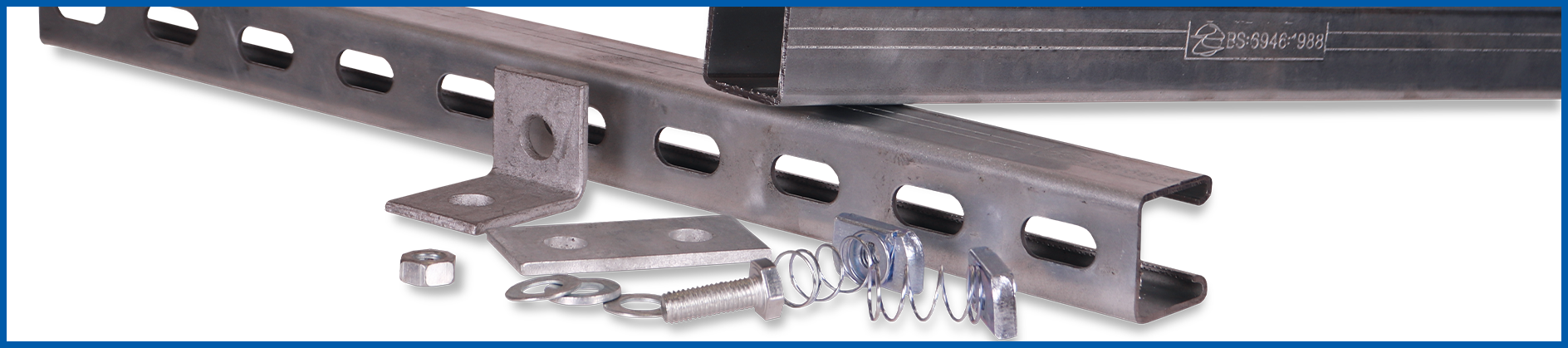
Channel Supports are versatile, highly adjustable infrastructure frameworks engineered specifically to support essential building services and mechanical installations. Designed as a functional, time-saving, and cost-effective alternative to conventional welded supports, these robust systems seamlessly integrate into commercial, trade, and domestic projects to efficiently manage utilities. They eliminate the need for complex on-site fabrication or specialist tools, allowing contractors to construct completely reusable support structures for critical frameworks like cable trays, cable ladders, ductwork, and pipework.
What are the choices when it comes to Channel Supports?
At F.H.Brundle, our primary choices revolve around a versatile range of channels, specialized fastenings, and heavy-duty brackets designed to create bespoke infrastructure frameworks. All options are supplied with a hot-dip galvanised finish to BS729 standards, offering completely adjustable and reusable solutions for supporting cable management and mechanical services.
| Feature Category | Key Benefit | Detail |
|---|---|---|
| Versatility & Adjustability | Fully adaptable layout | The system is 100% adjustable and completely reusable, allowing for easy layout alterations as building requirements change. |
| Installation Efficiency | Cost-effective and time-saving | Provides a practical alternative to conventional support methods without the need for welding, on-site fabrication, or specialist tools. |
| Durability & Protection | Long-lasting corrosion resistance | All components are hot-dip galvanised to BS729 standards, ensuring maximum durability across commercial, trade, and domestic environments. |
| Application Range | Multi-purpose utility support | Designed to easily create secure frameworks for building services, specifically for supporting cable trays, cable ladders, ductwork, and pipework |
| Component System | Comprehensive assembly options | Comprises a full range of durable channel profiles, specialised fastenings, and heavy-duty bracketry to construct bespoke support structures. |
Where can Channel Supports be used?
Channel Support Systems are highly versatile and can be used across commercial, trade, and domestic environments.
Specifically, they are used to design and construct frameworks for holding and protecting critical building services, including:
• Cable Management: Supporting cable trays and cable ladders.
• Mechanical Services: Hanging or supporting essential ductwork and pipework.
• On-Site Frameworks: Anywhere a temporary or permanent, 100% adjustable support structure is needed without the requirement of welding or specialist tools.
Why are Channel Supports so popular?
Channel Support Systems are highly popular because they offer a fast, economical, and hassle-free alternative to traditional building support methods.
Here is exactly why they are preferred on construction sites:
(1) Zero Welding Required: They eliminate the need for complex, time-consuming on-site fabrication or specialist tools.
(2) 100% Adjustable & Reusable: Unlike permanent welded frameworks, these systems can be easily modified on-site if building requirements change. The entire setup can be completely deconstructed and adapted for re-use on future projects.
(3) Maximum Durability: All components are hot-dip galvanised to BS729 standards, giving them superior corrosion resistance that stands up to demanding commercial, trade, and domestic environments.
(4) Effortless Assembly: By simply combining the standard channel lengths with their specialized fastenings and heavy-duty brackets, installers can build robust, tailored frameworks for critical services with minimal effort.
FAQs
Yes, Straightcurve edging and raised garden beds can be installed in almost any soil type, including heavy clay, sandy, rocky, or loose soil.
Depending on the specific ground conditions you encounter during installation, a few slight adjustments to the standard fixing method will ensure a secure fit:
• Soft or Sandy Soil: Standard fixing pegs may not hold securely in loose earth. Use longer pegs or anchor posts, or drive pegs in at opposing angles (cross-pegging) to create additional resistance against movement.
• Hard, Compact, or Rocky Soil: Pre-drilled pilot holes along the base edge of the panels allow you to place the stainless steel pegs at intervals. Pegs can be moved easily where rocks and stones may prevent full penetration of the substrate.
• Heavy Clay Soil: Clay expands and contracts significantly between wet and dry seasons. Ensure joints are properly locked and anchored with adequate ground stakes so soil movement doesn’t displace the edging alignment over time.
Yes. All frameless systems are well suited to composite decking installations. For compliance, fix to the structural subframe beneath the deck boards rather than to the boards themselves. The subframe must be engineered to carry the additional point loads from the fixings. F.H.Brundle supplies both the aluminium subframe systems and structural-grade polymer blocking required to achieve this.
Grade 316 stainless steel is the minimum for standard external UK environments. For coastal locations, pool surrounds, or any application involving regular exposure to saltwater or chlorinated water, Duplex 2205 stainless steel is the correct specification. Duplex 2205 offers approximately twice the strength of 316 and significantly better resistance to pitting and crevice corrosion. Grade 304 should only be used for fully internal, sheltered applications.
A channel system uses a continuous U-shaped aluminium or stainless steel track fixed to the floor or fascia, into which the glass panels are set. A spigot system uses individual point fixings set into the floor at intervals, with each panel clamped at its base. Channels give a lower-profile, more continuous visual result. Spigots allow water to drain freely beneath the glass and are better suited to decking and pool surrounds. Both are frameless systems requiring laminated toughened glass.