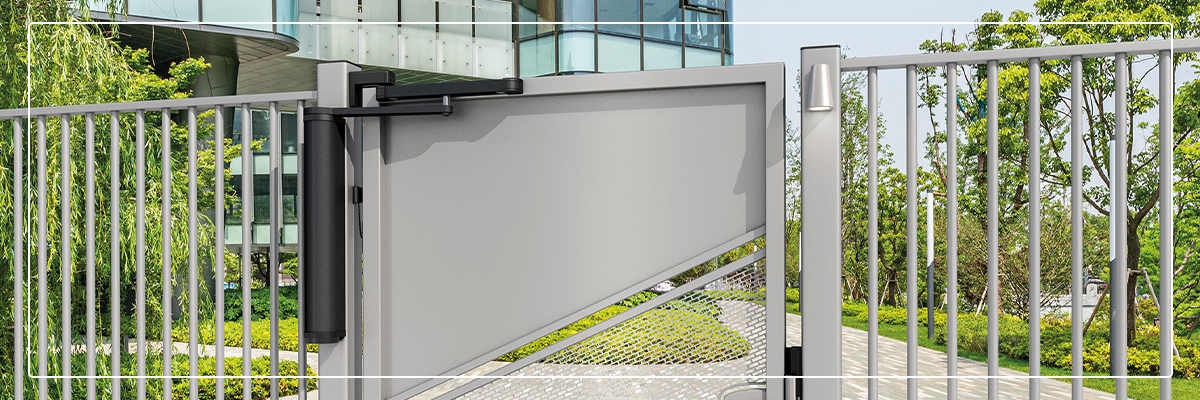
Why Choose Gate Closers?
Gate closers for smooth, controlled and reliable
self-closing
A gate closer is designed to bring a gate back towards the closed position after it has been opened. The right gate closer can help improve convenience, security and controlled access while providing smooth and consistent gate operation.
F.H.Brundle supplies a wide range of gate closers for domestic, commercial and industrial applications, including hydraulic gate closers, adjustable gas gate closers and self-closing hinge and closer systems.
Whether you’re a homeowner looking to make a garden gate self-closing, an installer fitting a pedestrian or access gate, or an architect or specifier selecting hardware for a larger project, choosing the right gate closer starts with understanding the gate’s weight, width, opening angle, construction, frequency of use and installation requirements.
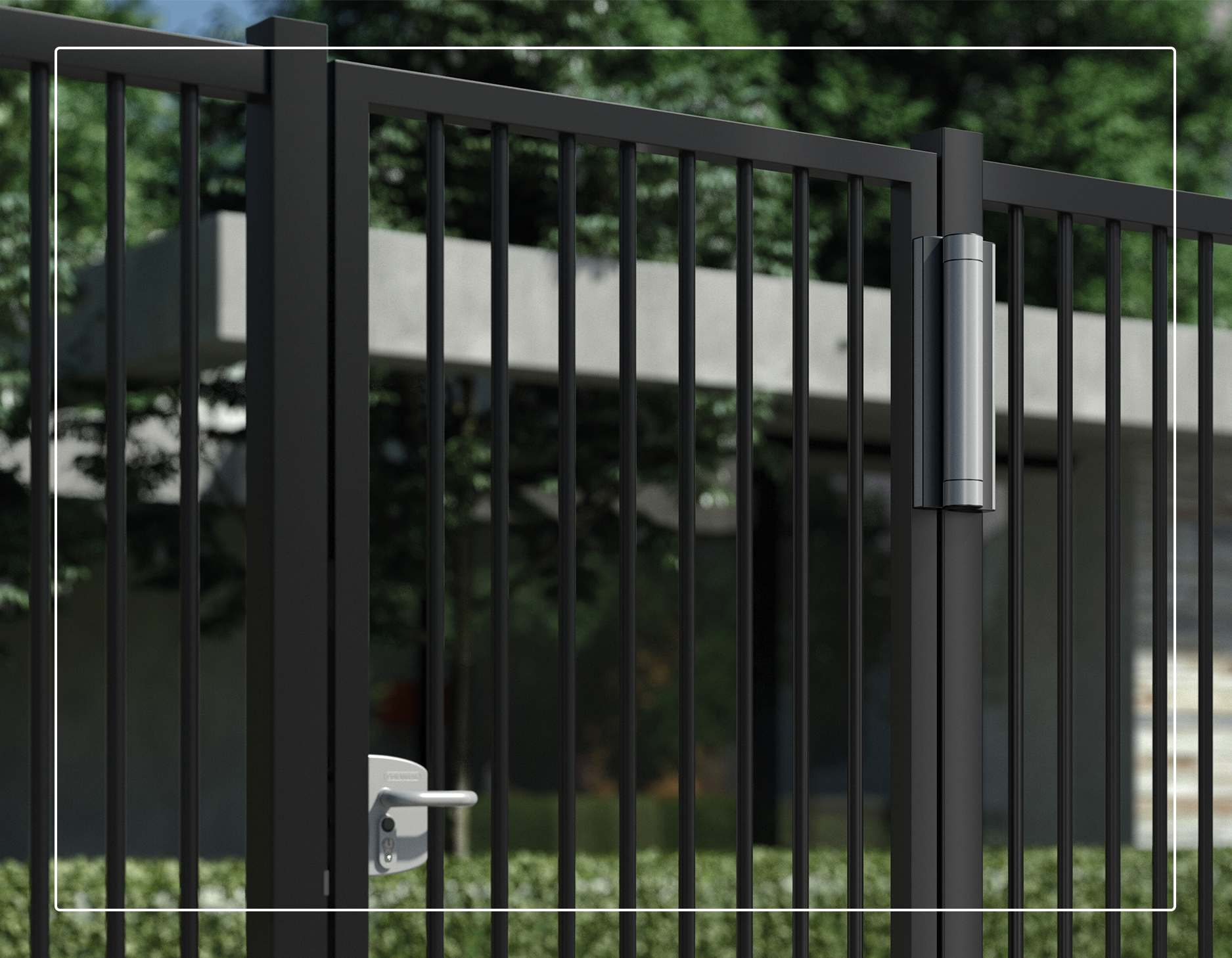
What is a Gate Closer?
A gate closer is a mechanical device that automatically moves a gate towards its closed position after it has been opened.
Gate closers can use different mechanisms, including hydraulic damping, gas struts or integrated hinge and closer systems. Depending on the product, closing speed, closing force and final closing action may be adjustable.
F.H.Brundle’s range includes solutions designed for wooden and metal gates, pedestrian gates, garden entrances, playgrounds, schools, industrial sites and admission-control applications.
A gate closer is particularly useful where a gate needs to close reliably without relying on the person using it to close it manually.
Why use a Gate Closer?
A suitable gate closer can provide several practical benefits:
• Automatic closing – helps return the gate towards the closed position after use.
• Controlled movement – hydraulic damping can help prevent a gate from closing too quickly.
• Improved security – a gate that closes automatically can help maintain controlled access.
• Convenience – users don’t need to manually close the gate after passing through.
• Consistent operation – adjustable closers can allow closing force and speed to be tailored to the installation.
• Flexibility – different closer designs are available for different gate weights, widths and mounting arrangements.
F.H.Brundle’s Locinox range uses mechanical springs with patented oil damping, with closing speed and closing force adjustable on applicable products.
How to choose the right Gate Closer
There isn’t one gate closer that is suitable for every application. The correct product depends on the characteristics of the gate and how it will be used.
Gate weight
Gate weight is one of the most important factors when selecting a closer.
The closer needs to be capable of handling the complete finished gate, including the frame, infill, decorative elements and other hardware.
F.H.Brundle offers closers for a range of gate weights, from compact solutions for lighter pedestrian gates through to heavy-duty hydraulic systems designed for gates weighing up to 200kg. For example, the Locinox Mammoth HD2 is specified for gates up to 200kg and 2m wide.
Always check the individual product’s maximum gate weight before installation.
Gate width and size
Gate width can affect the forces acting on a closer.
A wider or heavier gate may require a more powerful closer than a smaller pedestrian gate, even where the overall construction appears similar.
For example:
• Locinox Lion: up to 75kg and 1.1m wide
• Locinox Panther: up to 150kg and 1.5m wide
• Locinox Mammoth HD2: up to 200kg and 2m wide
These specifications demonstrate why both gate weight and width should be considered when selecting a closer.
Gate material and construction
Gate closers can be used with different gate constructions, including metal and wooden gates, depending on the product.
The method of mounting the closer is also important. Some products are designed for post or wall mounting, while others integrate with the gate’s hinge arrangement or are fitted directly to the gate and post.
Always check the manufacturer’s installation requirements to make sure the closer is compatible with the gate frame and supporting structure.
Opening angle
Consider how far the gate needs to open before selecting a closer.
Different products provide different opening angles. F.H.Brundle’s range includes products designed for 90°, 120° and 180° opening applications.
For example, the Locinox Panther has a maximum opening of 120°, while the Lion and Mammoth HD2 provide self-closing operation through a 180° opening angle.
Closing speed
Closing speed determines how quickly the gate returns towards its closed position.
Hydraulic gate closers can provide controlled movement, and several F.H.Brundle products allow the closing speed to be adjusted.
This can be particularly useful where a gate needs to close smoothly rather than swing rapidly into the closed position.
The Locinox Panther, for example, has adjustable closing speed and final snap.
Closing force
The closer must generate sufficient force to return the gate to the closed position, while still allowing the gate to be opened comfortably.
Some F.H.Brundle closers provide adjustable closing force. The GSB adjustable gas gate closer, for example, allows the closing force to be adjusted by changing the closer’s position on its brackets.
This adjustment can help installers fine-tune the closer to suit the finished installation.
Self-closing hinges are designed to return the gate towards the closed position after it has been opened.
They can be particularly useful where a gate needs to close automatically after pedestrian use.
F.H.Brundle’s TruClose hinge range includes adjustable self-closing functionality, with the ability to adjust closing speed.
Ideal for: pedestrian gates, garden gates and high-use areas where controlled closing is desirable.
Types of Gate Closer
Hydraulic gate closers
Hydraulic gate closers use hydraulic damping to control the gate’s closing movement.
They are available in a variety of configurations, from compact closers for pedestrian gates through to heavy-duty systems for larger gates.
F.H.Brundle’s range includes Locinox hydraulic closers with adjustable closing speed and, on selected products, adjustable final snap and closing force.
Ideal for: pedestrian gates, commercial entrances, industrial applications and installations where controlled closing is important.
Adjustable gas gate closers
Gas gate closers use a gas strut to generate closing force.
F.H.Brundle’s GSB adjustable gas gate closers are available with weld-fix or screw-fix brackets and are designed for gates up to 80kg. A separate version is available for gates up to 150kg.
The brackets allow installers to adjust the closing force without needing to replace the closer.
Ideal for: metal gates and installations where a straightforward, adjustable gate-closing solution is required.
Self-closing hydraulic hinge and closer systems
Some gate closers combine the closer and hinge function into one system.
The Locinox Tiger, for example, is a self-closing hydraulic hinge with a 180° opening angle, supplied with a Puma bottom hinge. It is specified for gates up to 75kg and 1.1m wide.
The Locinox Mammoth HD2 combines a powerful hydraulic closer with a Raptor bottom hinge and is designed for gates up to 200kg and 2m wide.
Ideal for: installations where an integrated hinge and closer solution is preferred.
Wall-mounted gate closers
Wall-mounted closers can be useful where conventional post-mounted installation isn’t suitable.
The Locinox Verticlose 2 is specifically designed for wall mounting and uses an arm that turns around the post or wall. It provides closing force through a 180° opening angle and is specified for gates up to 150kg and 1.5m wide.
Ideal for: gates positioned against walls, masonry structures or installations with restricted mounting options.
Gate Closers for Home Owners
For homeowners, a gate closer can provide a simple way to make a garden or pedestrian gate automatically return towards the closed position.
Before choosing a closer, establish:
1. How much does the complete gate weigh?
2. How wide is the gate?
3. What is the gate made from?
4. How far does it need to open?
5. Does it need controlled or adjustable closing?
6. Where can the closer be mounted?
7. Does the gate need to close gently or with a final snap?
For smaller domestic gates, F.H.Brundle offers compact options including galvanised steel gate closers for gates up to 40kg and 60kg.
For heavier or more frequently used gates, a hydraulic or adjustable gas closer may provide greater control and adjustment.
Gate Closers for Installers
For installers, selecting a gate closer is about matching the closer to the complete gate installation.
Consider:
• Maximum gate weight
• Maximum gate width
• Gate construction
• Opening direction
• Required opening angle
• Mounting arrangement
• Closing speed
• Closing force
• Final snap
• Frequency of use
• Environmental exposure
• Available adjustment
Adjustable closing
Adjustment can be particularly valuable during commissioning.
Gate weight, hinge alignment, installation tolerances and site conditions can all affect how a gate behaves. A closer with adjustable force or speed gives the installer greater control over the finished installation.
The F.H.Brundle range includes products with adjustable closing speed, closing force and final snap depending on the model.
Installation method
Check whether the closer is designed for:
• Weld fixing
• Screw fixing
• Post mounting
• Wall mounting
• Integration with a hinge
• Installation within the gate frame
For example, the GSB gas closer is available with weld-on brackets or screw-fixed brackets, while the Panther can be mounted to a post or wall.
Gate Closers for Balustrade and Balcony Installers
Gate closers can also form part of access-control solutions used alongside balustrades, balconies, terraces and other pedestrian-access areas.
However, a gate closer should not be selected simply because it physically fits the installation. The gate, supporting structure, fixing arrangement and intended use all need to be considered.
For installers working on projects incorporating balustrades or balcony systems, pay particular attention to:
• Available mounting space
• Gate and frame construction
• Fixing substrate
• Environmental exposure
• Corrosion resistance
• Gate weight and width
• Opening angle
• Required closing speed
• Required closing force
• Compatibility with locks, latches and access-control hardware
• Appearance and architectural finish
Where a project has specific safety, accessibility or regulatory requirements, the selected gate closer and complete gate assembly should be assessed against the relevant project requirements.
F.H.Brundle supplies gate hardware alongside its wider handrailing and balustrade product ranges, providing components for a broad range of architectural and construction applications.
Gate Closers for Architects and Specifiers
For architects and specifiers, the gate closer should be considered as part of the complete gate and access-control system rather than as an isolated component.
What should be specified?
A gate closer specification may need to identify:
| Requirement | What to Specify |
|---|---|
| Gate weight | Maximum completed gate weight |
| Gate width | Maximum gate width |
| Gate construction | Steel, aluminium, timber or other construction |
| Opening angle | Required maximum opening |
| Closing action | Controlled closing, final snap or both |
| Adjustment | Closing speed and/or closing force where required |
| Mounting | Wall, post, gate frame or hinge-integrated |
| Material/finish | Appropriate finish for the environment and aesthetic |
| Operating environment | External, exposed, high-use or specialist environment |
| Opening direction | Left-hand, right-hand or both |
| Compatibility | Hinges, locks, latches and access-control equipment |
Specifying these requirements early can help installers select a suitable product and reduce the risk of incompatibility during installation.
Gate Closer Comparison
| Gate Closer Type | Typical Application | Main Advantage | Key Considerations |
|---|---|---|---|
| Galvanised steel closer | Lightweight domestic gates | Simple and economical closing solution | Check maximum gate weight |
| Gas gate closer | Metal and fabricated gates | Adjustable closing force | Check mounting arrangement and gate weight |
| Hydraulic gate closer | Pedestrian, commercial and industrial gates | Controlled closing and adjustable operation | Check opening angle, weight and width |
| Integrated hydraulic hinge/closer | Pedestrian gates | Combines hinge and closing function | Check gate dimensions and hinge compatibility |
| Wall-mounted hydraulic closer | Gates beside walls or masonry | Flexible mounting arrangement | Check wall structure and required opening angle |
| Heavy-duty hydraulic closer | Large and heavy gates | Suitable for higher gate weights | Check maximum gate width, profile and installation requirements |
Specifying these requirements early can help installers select a suitable product and reduce the risk of incompatibility during installation.
Examples from the F.H.Brundle Range
| Product | Maximum Gate Weight kg | Maximum Width m | Maximum Opening degree | Notable Features |
|---|---|---|---|---|
| IBFM 91002 galvanised steel spring closer | 40 | — | — | Galvanised steel construction |
| IBFM 91003 galvanised steel spring closer | 60 | — | — | Galvanised steel construction |
| GSB adjustable gas closer | 80 | 1.2 | — | Adjustable force; weld or screw fixing options |
| Locinox Lion | 75 | 1.1 | 180 | Adjustable force and closing speed; Quick-Fix mounting |
| Locinox Tiger | 75 | 1.1 | 180 | Hydraulic self-closing hinge; Puma bottom hinge included |
| Locinox Panther | 150 | 1.5 | 120 | Post or wall mounting; adjustable speed and final snap |
| APS hydraulic closer and top hinge kit | 150 | — | — | Hydraulic; no power required; adjustable top hinge |
| Locinox Verticlose 2 | 150 | 1.5 | 180 | Wall mounting; adjustable speed and final snap |
| Locinox Mammoth HD2 | 200 | 2.0 | 180 | Heavy-duty hydraulic closer with Raptor bottom hinge |
Important: Specifications vary between individual products. Always check the current product page, technical drawing and manufacturer’s installation instructions before specifying or installing a gate closer.
How to choose a Gate Closer?
Use these steps to narrow down the right product:
1. Measure the gate
Record the gate’s height and width.
2. Establish the finished gate weight
Include the frame, infill, decorative components and hardware.
3. Determine the required opening angle
Decide whether the gate needs to open to 90°, 120°, 180° or another angle.
4. Decide how the closer will be mounted
Consider whether the closer needs to be mounted to a post, wall, gate frame or integrated with the hinge.
5. Determine the required closing action
Decide whether you need controlled closing, adjustable closing speed, final snap or adjustable closing force.
6. Consider the environment
For external applications, check the closer’s material and corrosion resistance.
7. Check compatibility
Make sure the closer works with the gate’s hinges, latch, lock and any access-control equipment.
8. Check the product specification
Confirm maximum gate weight, maximum gate width, opening angle and all other relevant product limitations before installation.
Need help choosing a Gate Closer?
The right gate closer depends on the gate weight, width, opening angle, construction, mounting arrangement and required closing action.
If you’re unsure which product is appropriate, start with these five measurements and requirements:
Gate weight → Gate width → Opening angle → Mounting position → Closing requirements
You can then compare the requirements against the individual F.H.Brundle product specifications to find a suitable solution.
FAQs
A gate closer is a mechanical device that automatically returns a gate towards the closed position after it has been opened. Depending on the design, gate closers can use hydraulic damping, gas struts, mechanical springs or an integrated hinge and closer system to control the closing movement.
Gate closers are available for gates of different weights. F.H.Brundle’s range includes solutions for lightweight domestic gates through to heavy-duty hydraulic closers designed for gates weighing up to 200kg. Always check the individual product specification for its maximum gate weight and width before installation.
Hydraulic gate closers use hydraulic damping to control the gate’s closing movement, while gas gate closers use a gas strut to provide closing force. Hydraulic models can offer controlled and adjustable closing, while gas closers provide a straightforward solution with adjustable closing force on suitable models.
Some gate closers allow the closing speed to be adjusted. This can be particularly useful where you want the gate to close smoothly rather than close too quickly. The available adjustment varies between products, so check the individual product specification.
Opening angles vary between gate closers. F.H.Brundle’s range includes solutions for applications requiring 90°, 120° and 180° opening angles. Always check the maximum opening angle of the chosen product before installation.
Yes. Some gate closers are specifically designed for wall mounting. For example, the Locinox Verticlose 2 is designed for wall mounting and is suitable for gates up to 150kg and 1.5m wide. Other models can also offer post or wall mounting depending on the installation requirements.
Some products combine the functions of a hinge and closer into a single system. For example, integrated hydraulic hinge and closer systems are available for pedestrian gates. However, not every gate closer replaces a hinge, so compatibility with the existing gate hardware should always be checked.
Yes, certain gate closers are designed for commercial, industrial and other frequently used applications. When choosing a closer for a high-traffic gate, consider the gate’s weight and width, frequency of operation, required closing speed and the closer’s specified application.
A gate closer is a separate closing mechanism that can be mounted to the gate, post or wall, depending on the design. A self-closing hinge incorporates the closing function into the hinge itself. The most suitable option depends on the gate design, available fixing space and required closing performance.