Why choose Gate Infill Boards?
Aluminium and composite gate infill boards for
modern gates
Create a practical, attractive and low-maintenance gate with gate infill boards from F.H.Brundle.
Our range includes lightweight aluminium gate infill boards from the Marano® Integrated system and composite/WPC gate infill boards from the Rinato™ range. Both provide alternatives to traditional timber gate infill, with different appearances, installation approaches and design possibilities.
Whether you’re a homeowner designing a garden gate, an installer fabricating a pedestrian or driveway gate, or an architect/specifier developing a contemporary boundary, the right gate infill can help determine the appearance, privacy and overall character of the finished gate.
What are Gate Infill Boards?
Gate infill boards are the boards or panels fitted inside a gate frame to create the main infilled surface.
They can be used to:
• Create a private gate
• Screen a garden or property
• Provide a contemporary alternative to timber
• Coordinate the gate with surrounding fencing
• Add colour and texture
• Create different levels of openness
• Complement architectural landscaping and garden design
F.H.Brundle supplies aluminium, WPC and polymer gate infill options, with the aluminium and WPC ranges particularly suited to modern privacy gates.
Choose the right Gate Infill Boards?
The two main options in this range offer different aesthetics and construction characteristics.
| Aluminium Gate Infill | Composite / WPC Gate Infill | |
|---|---|---|
| Range | Marano® Integrated | Rinato™ |
| Material | Aluminium | Wood Plastic Composite |
| Appearance | Contemporary metal finish | Natural wood-effect appearance |
| Weight | Lightweight | Solid composite board construction |
| Maintenance | Low maintenance | Low maintenance |
| Privacy | Can be configured as private or with gaps | Suitable for privacy gate applications |
| Design flexibility | Multiple board profiles, spacers and decorative screens | Boards can be installed horizontally or vertically |
| Colours | Contemporary colours plus mill-finish options | Six natural colour tones |
| Typical applications | Modern residential, architectural and commercial gates | Residential, garden, pedestrian and driveway gates |
| Key advantage | Lightweight, modular aluminium system | Wood-like appearance with composite construction |
| Gate fabrication | Designed as part of the Marano Integrated system | Can be framed within a suitable steel gate structure |
Aluminium Gate Infill Boards
Marano® Integrated
Marano® Integrated is a modular aluminium fencing system comprising boards, screens, posts and inserts. Its flexibility makes it suitable for creating coordinated fencing and gate designs.
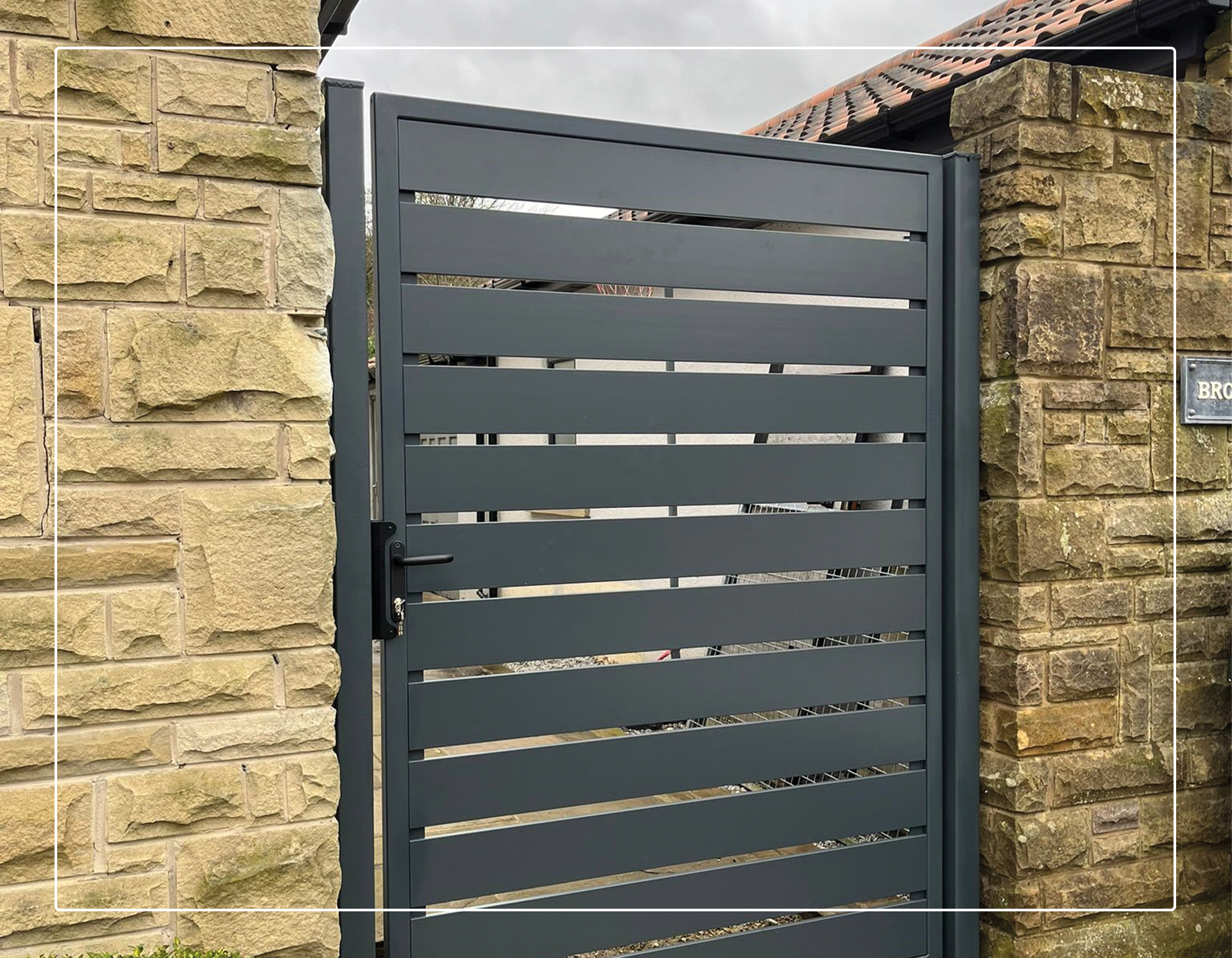
The system can provide complete privacy, or boards can be installed with gaps. Standard 25mm gaps can be increased to 50mm, 75mm or 100mm using spacers.
Why choose aluminium gate infill?
• Lightweight construction
• Long-lasting material
• Low-maintenance solution
• Contemporary appearance
• Multiple board profiles
• Choice of colours and finishes
• Flexible board spacing
• Decorative laser-cut screen options
• Can be coordinated with Marano fencing
Marano® Integrated board styles
| Board Style | Profile | Design Character | Suitable Applications |
|---|---|---|---|
| Half Round | 55mm section | Rounded profile | Contemporary residential gates |
| Parallel 50 | 50mm rectangular section | Slim, regular appearance | Modern gates and fencing |
| Parallel 100 | 100mm rectangular section | Wider board appearance | Privacy-focused gates and boundaries |
| Parallel 150 | 150mm rectangular section | Extra Wide board appearance | Privacy-focused gates and boundaries |
| Connect 150 | 150mm tongue-and-groove section | Broad, connected appearance | Substantial privacy gates and boundaries |
Aluminium gate infill: privacy and spacing options
One of the main advantages of Marano® Integrated is the ability to alter the visual openness of the gate.
| Configuration | Gap | Appearance | Typical Use |
|---|---|---|---|
| Privacy configuration | No intentional gap | Solid, screened appearance | Private gardens and side gates |
| Standard spacing | 25mm | Contemporary open design | Residential gates |
| Medium spacing | 50mm | More open appearance | Decorative boundaries |
| Wide spacing | 75mm | Increased visibility | Open garden boundaries |
| Maximum listed spacing | 100mm | Highly open appearance | Decorative/open fencing |
This flexibility allows the same general system to create anything from a privacy gate to a more open architectural gate.
Decorative aluminium gate infill
Gate infill doesn’t have to be completely solid.
Marano® Integrated can incorporate laser-cut aluminium decorative screens, allowing designers and homeowners to introduce patterns and feature sections into a gate.
The system includes full-height screens measuring 1825mm high, available in different widths, while smaller 300mm-high screens can also be integrated with the Connect 150 system using the appropriate fixing kit.
| Gate Design | Result |
|---|---|
| Full aluminium board infill | Maximum screening |
| Spaced aluminium boards | Contemporary open appearance |
| Boards + laser-cut screen | Combination of privacy and decorative detail |
| Full-height decorative screen | Feature architectural gate |
| Mixed configurations | More bespoke gate designs |
Composite Gate Infill Boards
Rinato™ composite fencing and gate infill
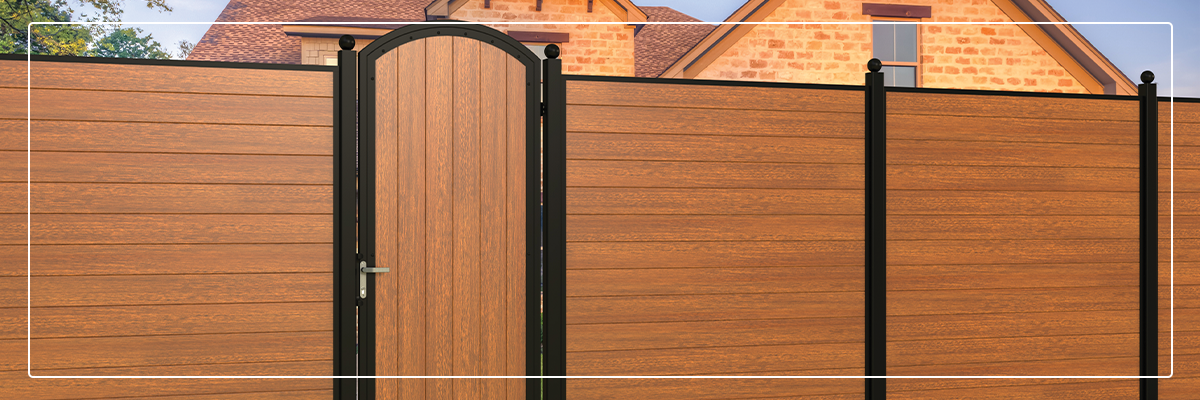
Rinato™ composite boards provide a different aesthetic from aluminium, combining the appearance of timber with the characteristics of a modern composite material.
The boards are manufactured using FSC-certified recycled wood and recycled plastics and feature a 360° Capstock shield. F.H.Brundle describes the boards as moisture resistant, UV resistant and resistant to staining and scratching.
They are available in six colour tones:
• Jet Black
• Anthracite
• Teak
• Charcoal
• Light Grey
• Walnut
Each board is 21mm thick and 160mm deep, with 1.82 and 3.6m board options available within the range.
Composite gate infill board benefits
| Feature | Benefit |
|---|---|
| Wood-effect appearance | Creates a more natural-looking gate |
| Composite construction | Alternative to traditional timber |
| Recycled materials | Manufactured using FSC-certified recycled wood and recycled plastics |
| Moisture resistant | Suitable for applications where moisture exposure is a consideration |
| UV resistant | Designed to resist UV-related fading |
| Scratch resistant | Helps maintain appearance during use |
| Low maintenance | Reduces the ongoing maintenance associated with traditional timber |
| Six colours | Provides options for different architectural and garden styles |
| Horizontal or vertical installation | Greater flexibility when designing the gate |
| Gate fabrication compatible | Can be installed within a suitable steel gate frame |
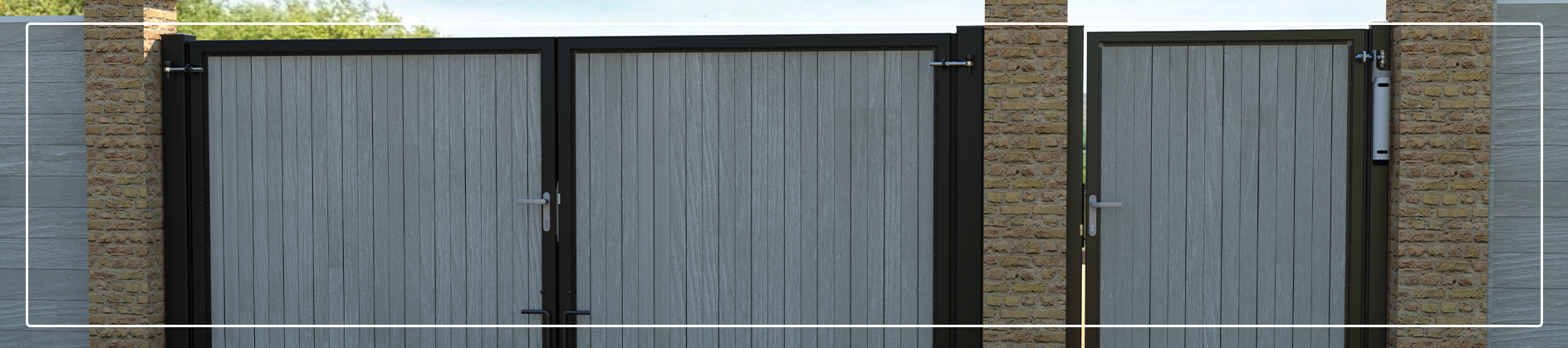
F.H.Brundle specifically shows Rinato™ boards being used as infill in both pedestrian and driveway gates, horizontally or vertically within a steel gate frame.
Aluminium vs Composite Gate Infill: Which should you choose?
The best choice depends on the required appearance, gate construction, privacy level, maintenance expectations and project specification.
| Consideration | Aluminium | Composite / WPC |
|---|---|---|
| Best for | Contemporary architectural designs | Natural/wood-effect designs |
| Appearance | Modern metal | Timber-inspired |
| Privacy | Configurable using board spacing | Solid board infill |
| Weight | Lightweight | Composite board |
| Maintenance | Low | Low |
| Colour choice | Contemporary aluminium finishes | Six natural tones |
| Decorative options | Laser-cut screens available | Wood-effect board appearance |
| Installation flexibility | Modular system | Horizontal or vertical board installation |
| Ideal for homeowners | Modern, minimalist gates | Traditional or natural-looking gardens |
| Ideal for installers | Integrated modular system | Straightforward framed-board construction |
| Ideal for architects | Extensive configuration options | Natural material aesthetic |
Gate Infill Boards for Home Owners
For homeowners, choosing gate infill is primarily about appearance, privacy, maintenance and how the gate fits with the surrounding property.
Consider these questions:
Do you want privacy?
Choose closely fitted aluminium boards or a suitable composite configuration.
Do you prefer an open gate?
Marano® Integrated allows gaps between aluminium boards.
Do you want a modern appearance?
Aluminium provides a clean contemporary aesthetic.
Do you prefer the look of timber?
Rinato™ composite boards provide a natural wood-effect appearance.
Do you want the gate to match your fence?
Using the same infill system across the gate and boundary can create a coordinated finish.
Gate Infill Boards for Installers
For gate fabricators and installers, the infill should be considered alongside the gate frame, hinges, locks and other gate hardware.
Before ordering, consider:
| Installation Consideration | What to Check |
|---|---|
| Gate dimensions | Overall width and height of the gate |
| Gate frame | Ensure the frame accommodates the chosen infill |
| Board orientation | Horizontal or vertical installation where applicable |
| Board quantity | Calculate the number of boards required |
| Privacy | Determine whether gaps are required |
| Gate weight | Consider the completed gate when selecting hinges |
| Hardware | Check hinges, locks, handles and closers |
| Fixings | Use appropriate fixings for the selected material and frame |
| Expansion | Allow for movement where specified by the manufacturer |
| Finish | Coordinate board colour with the gate frame and fence |
| Surrounding fencing | Consider how the gate will meet adjacent fence sections |
For example, F.H.Brundle specifies that its composite boards require an allowance for expansion due to temperature fluctuations, with a 5mm expansion gap at the start and end of each board recommended for the referenced product. Always check the current installation instructions for the exact product being used.
Gate Infill Boards for Architects and Specifiers
For architects and specifiers, gate infill should be selected as part of the complete boundary and gate design, rather than treated as an isolated component.
| Specification | Aluminium Marano® Integrated | Rinato™ Composite |
|---|---|---|
| Material | Aluminium | Wood Plastic Composite |
| Appearance | Contemporary | Natural wood effect |
| Privacy options | Multiple spacing configurations | Solid board configuration |
| Board profiles | Four main profiles | Consistent composite board |
| Decorative screens | Available | Not the primary system feature |
| Colours | Contemporary colours + mill finish | Six colour tones |
| Installation | Modular integrated system | Suitable for framed gate construction |
| Board orientation | Dependent on system configuration | Horizontal or vertical |
| Environmental considerations | Lightweight, low maintenance | Moisture, UV and scratch resistant |
| Best design application | Contemporary/architectural | Natural, timber-inspired designs |
Marano® Integrated also offers mill-finish aluminium that can be powder coated to a chosen RAL colour, providing additional flexibility where a project requires a specific colour specification.
Where are Gate Infill Boards?
1. Choose your material
Decide between aluminium for a contemporary metal aesthetic or composite/WPC for a wood-effect appearance.
2. Decide how much privacy you need
Marano® Integrated can be configured as a privacy system or with different gaps between boards.
3. Choose your style
For aluminium, select the Marano profile that best suits the gate design. For composite, select the colour and board orientation.
4. Consider the gate frame
Make sure the proposed board system is compatible with the gate frame and intended method of installation.
5. Think about the surrounding fence
A gate usually looks best when its infill complements the adjacent fencing in terms of colour, profile and spacing.
6. Consider hardware
The finished gate weight and construction should be taken into account when selecting hinges, locks, closers and other hardware.
7. Check installation requirements
Always follow the relevant manufacturer’s installation guidance, including any requirements for expansion, fixings and supporting structure.
Why choose F.H.Brundle Gate Infill Boards?
F.H.Brundle provides both aluminium and composite gate infill solutions, allowing customers to select a material and appearance appropriate to the project. Its gate infill range is specifically marketed for privacy gates and includes WPC, polymer and aluminium options.
The Marano® Integrated system goes beyond individual boards, incorporating posts, screens, inserts and spacers to create a coordinated fencing and gate system.
The Rinato™ composite range similarly offers boards that can be used as both fence and gate infill, with compatible aluminium rails and post inserts available as part of the wider system.
F.H.Brundle provides both aluminium and composite gate infill solutions, allowing customers to select a material and appearance appropriate to the project. Its gate infill range is specifically marketed for privacy gates and includes WPC, polymer and aluminium options.
The Marano® Integrated system goes beyond individual boards, incorporating posts, screens, inserts and spacers to create a coordinated fencing and gate system.
The Rinato™ composite range similarly offers boards that can be used as both fence and gate infill, with compatible aluminium rails and post inserts available as part of the wider system.
Residential
• Driveway Gates: For fully private, low-maintenance main entrances.
• Side Access/Pedestrian Gates: To secure alleys and back gardens from view.
• Garden & Patio Enclosures: For concealing bin stores, hot tubs, or seating areas.
Commercial
• Acoustic Perimeters: To block sightlines and reduce noise near roads/railways.
• Service Areas: For screening loading bays, HVAC units, or commercial waste bins.
• Residential Developments: For durable, high-traffic gated community entrances.
Public & Leisure
• Schools & Nurseries: For secure, private playground boundary gates.
• Parks & Sports Venues: For tough, low-upkeep public access and maintenance gates.
Why are Gate Infill Boards so popular?
• Total Privacy & Security: Unlike traditional open wrought iron or barred gates, solid tongue-and-groove infill boards completely block line-of-sight from the street, securing gardens, vehicles, and entrances.
• Zero Maintenance (No Painting or Rot): Natural timber warps, splits, and requires annual sanding, staining, or painting. Composite (WPC), polymer, and aluminium boards are completely weatherproof and UV-resistant—requiring only an occasional wipe down with water.
• Acoustic Noise Reduction: High-density solid polymer boards absorb and deflect ambient street noise, making them especially popular for properties near busy roads, schools, or railway lines.
• Installer & Trade Efficiency: For fabricators and installers, modular slot-in boards save significant workshop time compared to custom timber joinery. They slide directly into standard U-channels and steel box sections.
• Motor & Automation Friendly: Lightweight options like extruded aluminium significantly reduce the structural weight of large driveway gates, minimising wear and tear on hinges, posts, and gate automation motors.
• Modern Aesthetic Versatility: They bridge the gap between traditional and contemporary design, offering realistic woodgrain laminates or sleek powder-coated modern finishes (like Anthracite Grey).
FAQs
Gate infill boards are fitted within a gate frame to create the main infilled surface. They can provide privacy, screen a property or garden, add colour and texture, and create a contemporary alternative to traditional timber gate infill.
Yes. Rinato™ composite boards can be used as infill within suitable steel gate frames and can be installed horizontally or vertically, providing flexibility when designing pedestrian and driveway gates.
Both aluminium and composite gate infill options are designed as low-maintenance alternatives to traditional timber. Composite boards are designed to resist moisture, UV exposure, staining and scratching, while aluminium provides a lightweight, low-maintenance option.
Yes. Gate infill boards can be used for both pedestrian and driveway gates, provided the selected infill is compatible with the gate frame and the completed gate is appropriately designed for its weight and intended use. F.H.Brundle also supplies gate frame systems that can be clad with aluminium or WPC boards.
Yes. Composite boards can expand and contract with temperature changes. For the referenced Rinato™ 1.82m boards, F.H.Brundle recommends allowing a 5mm expansion gap at the start and end of every board. Always check the installation guidance for the specific product being used.
They can be used on automated gates, but the completed gate must be designed around the weight and wind loading of the chosen infill. The gate frame, hinges, posts and automation equipment should all be suitable for the finished gate.
Yes. Using the same or complementary infill material across a gate and adjacent fencing can create a more coordinated finish. Both Marano® Integrated aluminium and Rinato™ composite boards are available as part of wider fencing solutions.
Yes. Marano® Integrated can incorporate laser-cut aluminium decorative screens, allowing feature patterns to be combined with standard infill boards for a more bespoke gate design.
Consider the required level of privacy, the appearance you want, the weight of the completed gate, compatibility with the gate frame, board orientation, colour, spacing and the surrounding fencing. Hardware such as hinges, locks and gate closers should also be selected to suit the finished gate.