Why Choose Gate Locks?
Secure, reliable gate locks for domestic, commercial and architectural applications
The right gate lock provides more than a way to secure a gate. It needs to work reliably with the gate, hinges, closer and surrounding structure while providing the level of security and access control required for the application.
F.H.Brundle supplies a comprehensive range of gate locks for metal, steel, aluminium, timber and other gate constructions, including surface-mounted and insert locks for swing and sliding gates.
Whether you’re a homeowner securing a garden gate, an installer fitting a pedestrian or driveway gate, or an architect or specifier selecting hardware for a commercial or architectural project, choosing the right gate lock starts with understanding the gate construction, locking requirements, level of security, installation method and frequency of use.
What is a Gate Lock?
A gate lock is a locking mechanism designed to secure a gate in its closed position and control who can open it.
Gate locks are available in different designs depending on the type of gate, security requirements and method of access. These include key-operated locks, combination locks, insert locks, surface-mounted locks and specialist access-control solutions.
F.H.Brundle’s range includes locking solutions for both swing and sliding gates, with products suitable for metal and timber gate frames. The range also includes specialist solutions for applications where child safety, restricted access or emergency access is important.
How to choose the right Gate Lock?
There are several factors to consider before choosing a gate lock.
Gate type
Start by establishing whether the lock is being fitted to a:
• Pedestrian gate
• Garden gate
• Driveway gate
• Metal gate
• Steel gate
• Aluminium gate
• Timber gate
• Sliding gate
• Commercial or industrial gate
The gate type will influence the lock design, fixing method and available installation space.
F.H.Brundle supplies both swing-gate and sliding-gate locking solutions, giving installers options for different gate configurations.
Gate material and construction
The lock needs to be compatible with the gate frame and supporting structure.
Metal and aluminium gates may accommodate insert or surface-mounted locks, while timber gates may require a different installation arrangement.
For example, the Locinox Forty Lock is designed for metal, aluminium and PVC gates and uses a stainless steel mechanism, while the Locinox Eighty Lock is available specifically for wooden gates.
Always check the individual product specification and required profile dimensions before selecting a lock.
Level of security
Consider what the gate needs to protect and how access should be controlled.
A domestic garden gate may only require straightforward key-operated security, while a commercial site or restricted-access area may require a more sophisticated access-control solution.
Possible requirements include:
• Key-operated access
• Keypad or combination access
• Restricted access
• Child safety
• Emergency access
• Fire brigade access
• High-security locking
• Integration with wider access-control systems
F.H.Brundle’s range includes combination locks as well as specialist fire-brigade accessible and child-safety solutions.
Key or combination access
Traditional key-operated locks remain a practical choice for many residential and commercial gates.
Combination gate locks can remove the need to carry a physical key and can be particularly useful where multiple authorised users need access.
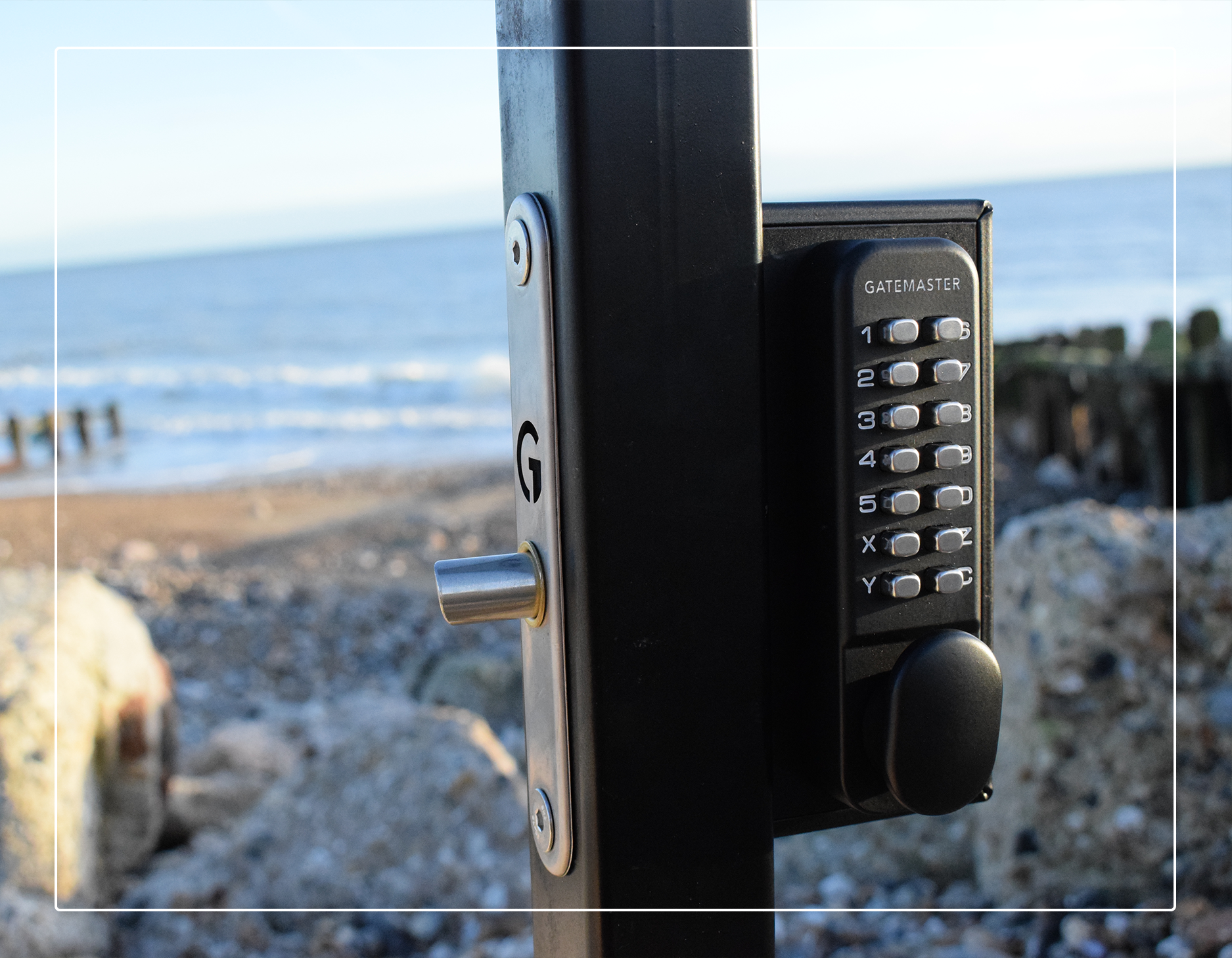
F.H.Brundle’s combination gate lock range includes mechanical keypad solutions that require no electrical power. The 10–30mm version features an adjustable latch bolt, automatic latching and keypad operation from both sides. It is also tested to over 1,000 hours of salt spray.
Surface-mounted or insert lock?
The installation method is another important consideration.
Surface-mounted gate locks
Surface-mounted locks are fitted onto the face or structure of the gate rather than being recessed into the gate frame.
Advantages include:
• Straightforward installation
• Useful where the gate profile doesn’t allow an insert lock
• Suitable for retrofit applications
• Available for different gate constructions
Insert gate locks
Insert locks are fitted within the gate profile, creating a more integrated appearance.
They can be particularly useful where the gate has a suitable box-section frame.
For example, F.H.Brundle’s Locinox Forty and Fifty Locks are insert locks designed for specific gate-profile depths. The Forty Lock is suitable for profiles of 40mm, while the Fifty Lock is designed for profiles of 50mm depth or more.
Types of Gate Lock
Key-operated gate locks
Key-operated locks provide conventional access control using a key and locking cylinder.
They are available in both surface-mounted and insert configurations and can be suitable for domestic, commercial and pedestrian gates.
F.H.Brundle supplies Locinox gate locks complete with cylinders and handles, as well as individual lock mechanisms where the cylinder and handles can be specified separately.
Ideal for: garden gates, pedestrian gates, driveway gates and applications requiring conventional keyed access.
Insert gate locks
Insert locks sit within the gate frame rather than being mounted entirely on its surface.
They can provide a clean, integrated appearance and are available for different profile sizes.
The Locinox Forty Lock, for example, has a stainless steel mechanism, adjustable self-latching bolt and hook, and is compatible with Euro profile cylinders. Its adjustable self-latching bolt can be continuously adjusted by up to 10mm without removing the lock box.
Ideal for: fabricated metal and aluminium gates where the gate profile is suitable for an insert lock.
Surface-mounted gate locks
Surface-mounted locks attach directly to the gate structure and can be useful where an insert lock isn’t appropriate.
They can provide a practical solution for both new installations and some retrofit applications.
F.H.Brundle stocks surface-mounted Locinox locking solutions for different gate profiles and applications.
Ideal for: metal gates, sliding gates and installations where an external lock body is preferred.
Combination gate locks
Combination locks provide keyless access using a mechanical keypad or code.
They can be particularly useful for shared entrances where multiple people need authorised access without each person having a key.
F.H.Brundle’s combination gate lock features automatic latching, an adjustable latch bolt and mechanical keypad operation, meaning it doesn’t require a power supply.
Ideal for: residential developments, shared entrances, commercial premises, schools, recreational facilities and controlled-access areas.
Sliding gate locks
Sliding gates require locking hardware designed around their movement and construction.
A sliding gate lock needs to secure the gate while allowing the sliding mechanism and surrounding hardware to operate correctly.
F.H.Brundle supplies dedicated sliding gate locks, including Locinox surface-mounted solutions with adjustable keeps and stainless steel mechanisms.
Ideal for: sliding driveway gates, commercial gates and industrial entrances.
Self-latching gate locks
A self-latching lock automatically engages when the gate closes.
This can be particularly useful when a gate is fitted with a gate closer, because the closer can bring the gate into the closed position while the lock automatically engages.
The Locinox Forty and Fifty Locks use adjustable self-latching bolts and hooks.
Ideal for: pedestrian gates and installations where automatic locking after closure is required.
Gate Locks for Home Owners
For homeowners, the right gate lock should provide the required level of security without making everyday use unnecessarily complicated.
Before choosing a lock, consider:
1. What type of gate do you have?
2. What is the gate made from?
3. Is it a pedestrian, garden or driveway gate?
4. Do you want key or keyless access?
5. Does the gate need to self-latch?
6. How much security do you require?
7. Will the lock be exposed to rain and other weather conditions?
8. Does the gate already have a closer or latch?
For a typical domestic pedestrian gate, a key-operated or combination lock may be appropriate. For shared access, a mechanical combination lock can remove the need to distribute keys.
Gate Locks for Installers
For installers, the main challenge is ensuring the selected lock is compatible with the physical construction of the gate.
Check:
Gate profile
Insert locks are designed for specific gate-profile dimensions. For example, the Locinox Forty Lock is designed for suitable 40mm profiles, while the Fifty Lock is intended for profiles of 50mm depth or more.
Backset and dimensions
Check the lock’s backset, lock-body dimensions, cylinder position and handle configuration before fabrication.
The Locinox Eighty Lock, for example, has a 60mm backset and is designed for profiles of 80mm depth or more.
Keep alignment
The lock and keep need to align correctly so that the bolt or hook can engage reliably when the gate closes.
Where adjustment is available, this can help accommodate installation tolerances and maintain reliable operation.
Gate closer compatibility
If the gate is fitted with a closer, check that the lock can reliably latch when the closer brings the gate into the closed position.
A self-latching lock can be particularly useful in this type of installation.
Finish and environment
For external gates, consider the lock’s material and finish in relation to exposure, corrosion and the appearance of the overall gate.
Gate Locks for Balustrade and Balcony Installers
Gate locks can form an important part of access-controlled openings within balustrade, balcony, terrace and pedestrian-access installations.
For these projects, lock selection should consider both function and architectural appearance.
Key considerations include:
• Gate frame dimensions
• Locking mechanism
• Available fixing space
• Material and finish
• Environmental exposure
• Required security level
• Access requirements
• Compatibility with hinges and closers
• Compatibility with access-control equipment
• Ease of use
• Maintenance requirements
Where a gate forms part of a balcony, terrace or balustrade installation, the lock should be considered alongside the complete system rather than selected independently.
F.H.Brundle supplies gate hardware alongside dedicated handrailing and balustrade product ranges, including Pro-Railing, frameless glass balustrade, Juliet balconies and other architectural systems.
Gate Locks for Architects and Specifiers
For architects and specifiers, gate lock selection should balance security, access control, durability, appearance and installation requirements.
A specification should identify the key performance requirements rather than simply stating “gate lock”.
Consider specifying:
| Requirement | What to Consider |
|---|---|
| Gate Type | Swing or sliding |
| Gate Material | Steel, aluminium, timber, PVC or other |
| Lock Type | Insert, surface-mounted, combination, specialist or other |
| Access method | Key, keypad, controlled access or other |
| Security level | Required level of resistance and access control |
| Self-latching | Whether the lock needs to latch automatically |
| Gate Profile | Profile dimensions and available lock space |
| Backset | Required lock backset |
| Cylinder | Cylinder type and compatibility |
| Handle | Required handle arrangement and finish |
| Environment | External, exposed, coastal or corrosive conditions |
| Finish | Colour, coating and architectural appearance |
| Emergency access | Whether specialist emergency/fire access is required |
| Integration | Compatibility with hinges, closers and access-control systems |
This approach gives installers enough information to select a compatible product and reduces the risk of specifying a lock that cannot be accommodated by the gate frame.
Gate Lock Comparison
| Gate Lock Type | Best Suited To | Main Advantage | Key Considerations |
|---|---|---|---|
| Key-operated lock | Domestic and commercial gates | Familiar, straightforward access | Requires keys and compatible cylinder |
| Insert lock | Fabricated metal and aluminium gates | Integrated appearance | Gate profile must accommodate the lock body |
| Surface-mounted lock | Metal, timber and sliding gates | Straightforward installation | Consider available mounting space |
| Combination lock | Shared or controlled-access gates | Keyless access | Code management and user access |
| Self-latching lock | Pedestrian gates | Automatically latches when closed | Must align correctly with the keep |
| Sliding gate lock | Sliding gates | Designed for sliding-gate applications | Check gate profile and keep arrangement |
| Specialist access lock | Fire, child-safety or restricted-access applications | Designed for specific access requirements | Check project-specific requirements |
Gate Lock Selection Guide
| If You Need… | Consider… |
|---|---|
| Traditional keyed access | Key-operated gate lock |
| A clean integrated lock in a metal gate | Insert gate lock |
| A straightforward external installation | Surface-mounted gate lock |
| Keyless access | Combination gate lock |
| A gate that locks automatically when it closes | Self-latching gate lock |
| A lock for a sliding gate | Sliding gate lock |
| A lock for a timber gate | A gate lock specifically compatible with timber construction |
| A lock for a metal or aluminium gate | A suitable insert or surface-mounted metal gate lock |
| Multiple authorised users without issuing keys | Combination or appropriate access-control lock |
| A specialist emergency-access requirement | Appropriate fire brigade/access-control solution |
Examples from the F.H.Brundle Gate Lock range
F.H.Brundle’s range includes locks for different gate constructions, installation methods and access requirements.
| Product / Type | Gate / Application | Notable Features |
|---|---|---|
| Locinox Forty Lock | Metal, aluminium and PVC gates | Stainless steel mechanism, self-latching bolt and hook, adjustable day bolt, Euro-cylinder compatible |
| Locinox Fifty Lock | Metal, aluminium and PVC gates | 30mm backset, designed for profiles of 50mm depth or more, adjustable self-latching bolt |
| Locinox Eighty Lock – Metal | Metal and aluminium gates | 60mm backset, stainless steel mechanism, self-latching bolt and hook |
| Locinox Eighty Lock – Wooden | Wooden gates | Stainless steel mechanism, adjustable self-latching bolt and hook |
| Locinox Gate Lock with Cylinder & Handle | Metal gate sections | Complete keyed solution for 10–20–30mm sections |
| Locinox Sliding Lock | Sliding gates | Surface mounted, stainless steel mechanism and adjustable keep |
| Combination Gate Lock | Controlled-access gates | Mechanical keypad, no power required, automatic latching and adjustable latch bolt |
| Locinox Key Drop | Gates requiring a lockable drop bolt | Cylinder-operated, three height positions and open/closed locking |
Always check the current individual product specification before ordering or specifying a gate lock. Profile dimensions, cylinder requirements, handles, keeps and other components can vary between products.
How to choose a Gate Lock?
Follow these steps to identify the right type of gate lock:
1. Identify the gate type
Establish whether you’re working with a swing gate, sliding gate, pedestrian gate, garden gate or driveway gate.
2. Check the gate material
Identify whether the gate is steel, aluminium, timber, PVC or another material.
3. Measure the gate profile
For insert locks in particular, check the profile dimensions, depth and available space.
4. Decide how users will gain access
Choose between key-operated, combination, specialist or integrated access-control solutions.
5. Determine the required security level
Consider whether the gate is protecting a garden, private property, commercial premises, restricted area or another environment.
6. Consider self-latching
If the gate is fitted with a closer, a self-latching lock may be useful so that the lock engages as the gate closes.
7. Check the fixing arrangement
Confirm whether the lock needs to be inserted, surface mounted, welded, bolted or fixed in another way.
8. Check the surrounding hardware
Ensure compatibility with the gate hinges, closer, keep, handles and any access-control equipment.
9. Consider the environment
For external gates, check the lock’s material and finish for suitability for the expected conditions.
10. Check the complete product specification
Confirm dimensions, backset, cylinder compatibility, handle requirements, fixing method and other technical details before installation.
Why choose F.H.Brundle Gate Locks?
F.H.Brundle supplies a comprehensive range of gate locks and locking hardware for swing and sliding gates, covering domestic, commercial, industrial and specialist applications. The range includes surface-mounted and insert solutions for metal and timber gate frames.
The range includes established manufacturers including Locinox, Borg, Welka and Gatemaster, giving installers and specifiers access to different locking technologies and configurations.
Alongside gate locks, F.H.Brundle supplies associated gate hardware including hinges, closers, lock keeps and boxes, drop bolts and catches, allowing components to be selected as part of a complete gate system.
Need help choosing a Gate Lock?
The right gate lock depends on five key factors:
Gate type → Gate material → Gate profile → Access requirements → Security requirements
Once these are established, you can select the appropriate lock type and check the individual product specification for dimensions, fixing requirements and compatibility.
FAQs
The right gate lock depends on the type, material and profile of the gate, as well as the required level of security and method of access. Key-operated, combination, insert, surface-mounted, self-latching and sliding gate locks are available for different applications. Always check the individual product specification to confirm compatibility with your gate.
Yes. F.H.Brundle supplies gate locks specifically designed for metal and aluminium gates, including both insert and surface-mounted options. Some insert locks are designed for specific gate-profile depths, so the profile dimensions should be checked before selecting a lock.
An insert gate lock is fitted within the gate frame, providing a more integrated appearance where the gate profile allows it. A surface-mounted lock is fitted onto the face or structure of the gate and can be useful where there is insufficient space for an insert lock or for certain retrofit applications.
Yes. F.H.Brundle supplies mechanical combination gate locks that provide keypad access without requiring an electrical power supply. These can be useful for shared entrances and applications where multiple authorised users need access without carrying individual keys.
Before choosing an insert lock, check the gate-profile depth, available space within the frame, lock backset, cylinder position and handle arrangement. Different locks are designed for different profile dimensions, so these measurements should be compared with the manufacturer’s product specification.
Yes, provided the lock and closer are compatible. A self-latching lock can be particularly useful because it allows the lock to engage as the closer brings the gate into the closed position. Correct alignment between the lock, keep and gate is important for reliable operation.
Yes. F.H.Brundle supplies dedicated sliding gate locks designed around the movement and construction of sliding gates. These include surface-mounted solutions with adjustable keeps and stainless steel mechanisms.
The range includes key-operated, combination, cylinder, child-safe, fire brigade, electromagnetic, latch, locking bolt, push bar, push pad, strike and weld-in gate locks, alongside specialist solutions from manufacturers including Locinox, Borg, Welka and Gatemaster.
Yes. F.H.Brundle supplies gate locks alongside other gate hardware, including hinges, closers, lock keeps and boxes, drop bolts, catches and gate automation components. This allows compatible hardware to be selected as part of a complete gate installation.