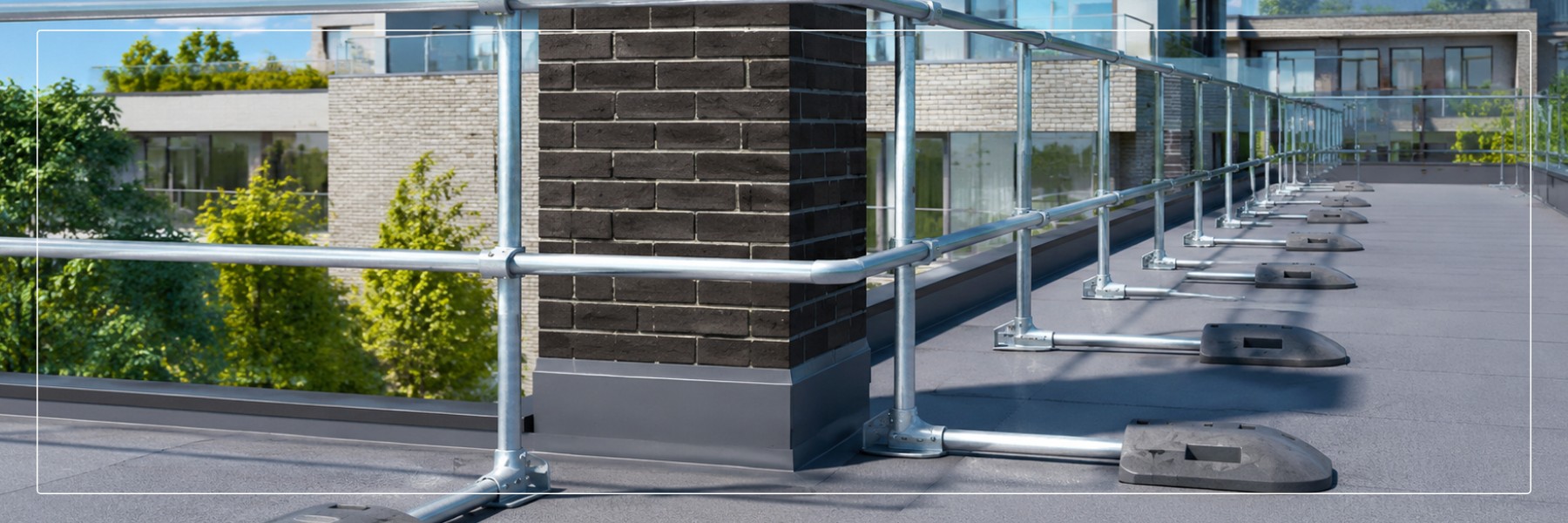
Roof Edge Protection Systems:
Collective Fall Protection
Safe, Compliant, and Reliable Height Safety Solutions
Ensure maximum safety for maintenance teams and contractors working at height. Our comprehensive range of roof edge guardrails offer permanent or temporary collective fall protection requiring no user training or personal fall arrest equipment (PPE).
Available in four distinct configurations, our edge protection options suit various roof types, aesthetics, and structural load constraints. F.H.Brundle’s Range consists of systems compliant with BS EN 13374:2013 Class A.
Quick Comparison:
Which Roof Guardrail System Do You Need?
| Guardrail System | Best Suited Roof Type | Fixing Method | Key Advantage | System Available |
|---|---|---|---|---|
| Freestanding | Flat roofs up to 3° pitch | Non-penetrative counterweights | Zero risk of roof membrane leaks | Defender / Roof Domes |
| Fixed | Parapets, concrete decks, coping | Permanent mechanical anchors | Rigid, highly secure, space-saving | See Handrail Standards |
| Folding / Collapsible | Heritage or sightline-sensitive roofs | Non-penetrative fold-down hinge | Invisible from ground level when flat | Foldsheild |
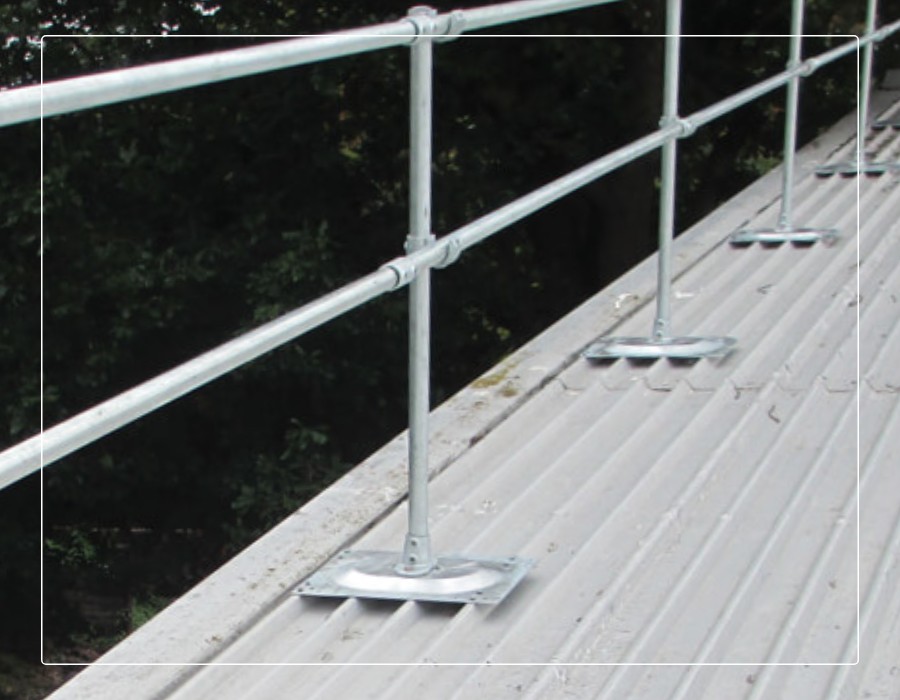
| Metal / Profiled | Standing seam, trapezoidal cladding | Seam clamps or structural rivets | Spreads weight evenly on industrial metal skins | Topfix |
Why Choose Our Modular Roof Guardrails?
• Zero or Minimal Roof Penetration: Systems engineered to protect both the operator and the long-term integrity of the roof membrane.
• Corrosion Resistant Durability: Manufactured from high-quality galvanised steel (to BS EN ISO 1461 standards) or in some components, lightweight, high-strength aluminium.
• Simple, Modular Assembly: Utilises standard tube and slip-on clamp components for fast, on-site installation without welding or specialised tools.
• Fully Tested Compliance: Extensively certified to meet stringent UK and European safety regulations.
Rood Edge Protection Systems Explained
Freestanding Roof Guardrail System (Defender):
When should you use a freestanding roof guardrail?
Use this system on flat roofs where membrane penetration is strictly prohibited. This non-penetrative roof safety guardrail relies on a proven counterweight design to deliver ultimate stability without puncturing the roof surface, completely eliminating the risk of future water leaks.
Ideal For: Flat roofs (up to a 3° pitch), asphalt, felt, bitumen, and single-ply membranes.
Technical Specifications:
• Utilises recycled, weather-resistant PVC counterweights (~25kg each).
• Completely modular; easily adjusted to navigate roof plant, solar panels, and corners.
• Supplied in standard Ø48.3mm galvanised steel tube.
• TUV Certificate no. Z1A 04 03 50796 001
• Designed to meet the requirements of BS 13700 – 2021
• Satisfies the CEN harmonised European standard BS EN ISO 14122-3:2001
Defender is available is three configurations; Economy, Standard and Plus:
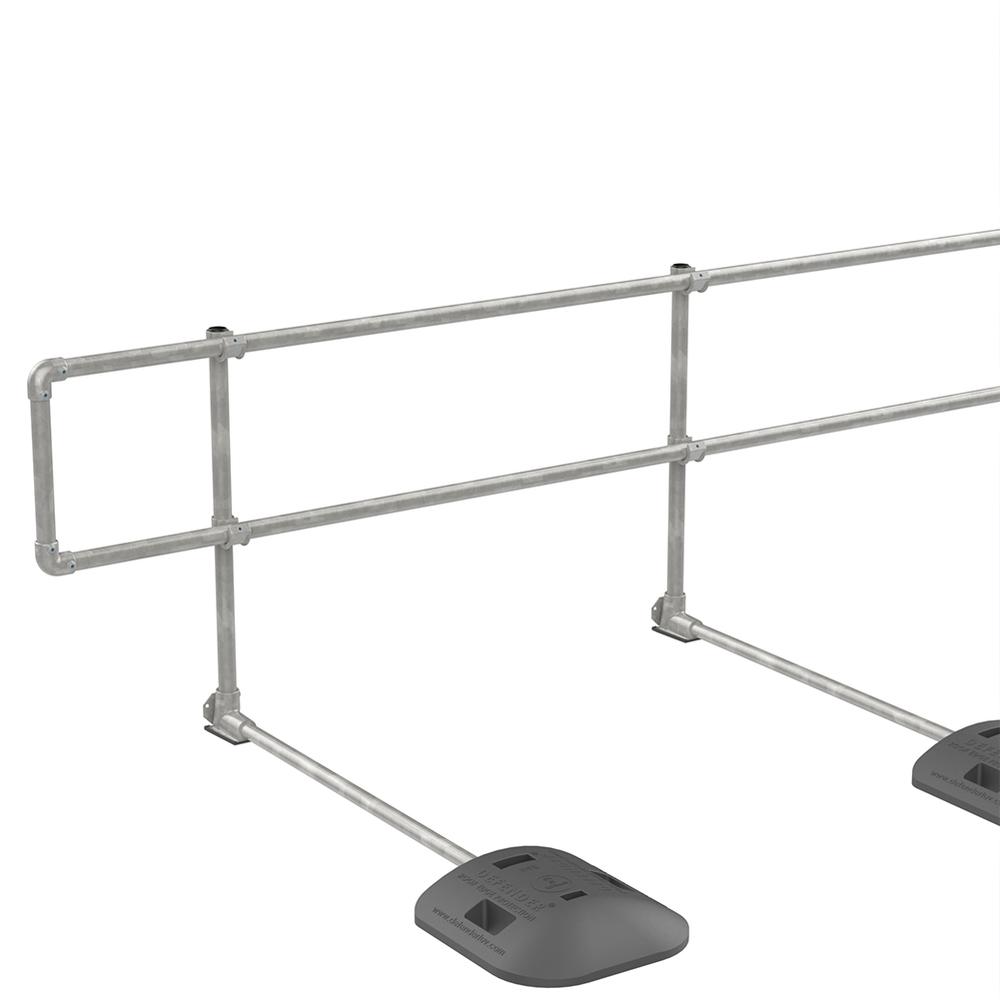
• Economy: uses the minimum required number of counterweights for a safe environment up to 5.6m distance. A simple and cost effective way of protecting roof edges. Uprights are positioned to a maximum bay size of 2.8m and counterweights (overall length 1942mm) are fitted on every other upright post to a maximum distance 5.6m
• Standard: Shorter length counterweight tubes, enables installation in restricted roof areas. Upright posts each fitted with counterweight assemblies (1442mm overall length) maximum bay sizes of 2.8m
• Plus: Aesthetically pleasing, curved uprights with 3 rails for added security. Upright posts placed at maximum bay sizes of 2.8m fitted with counterweight assemblies (1442mm overall length) on every other upright post maximum bay sizes of 5.6m
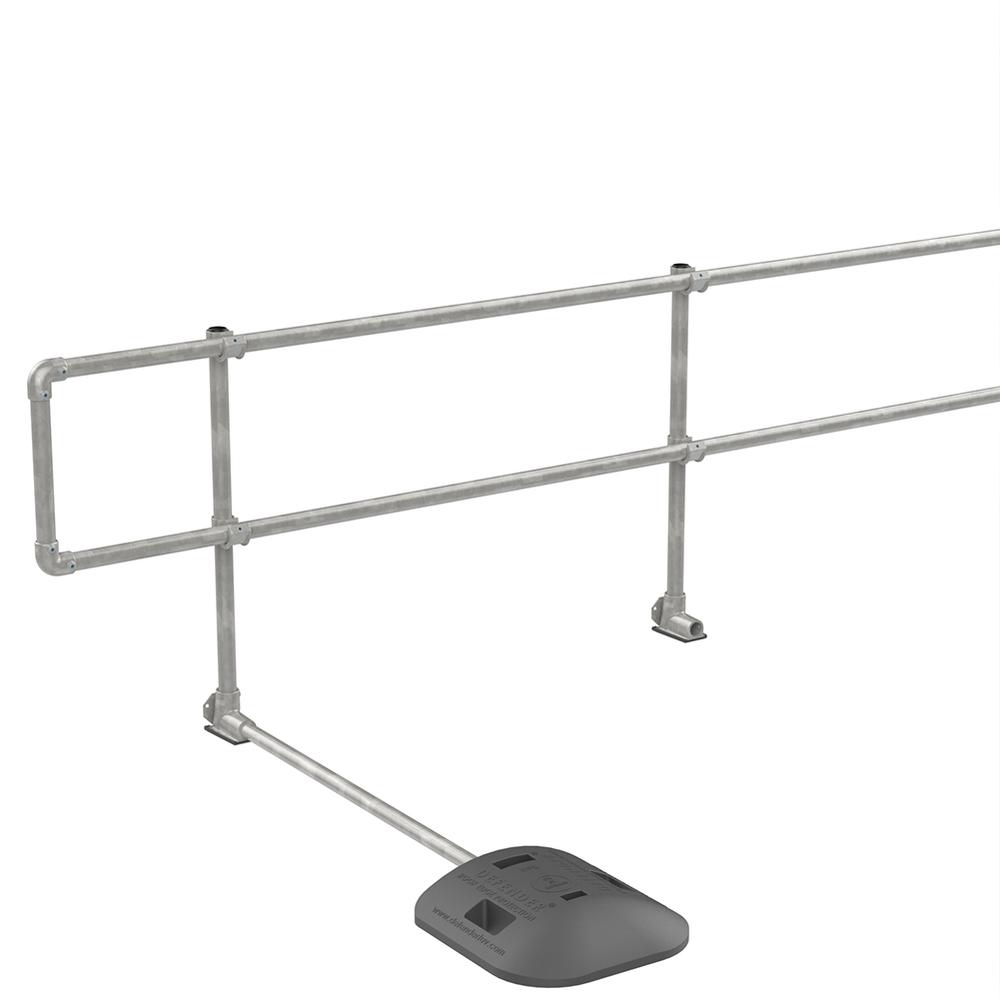
Defender Economy System
Defender Standard System
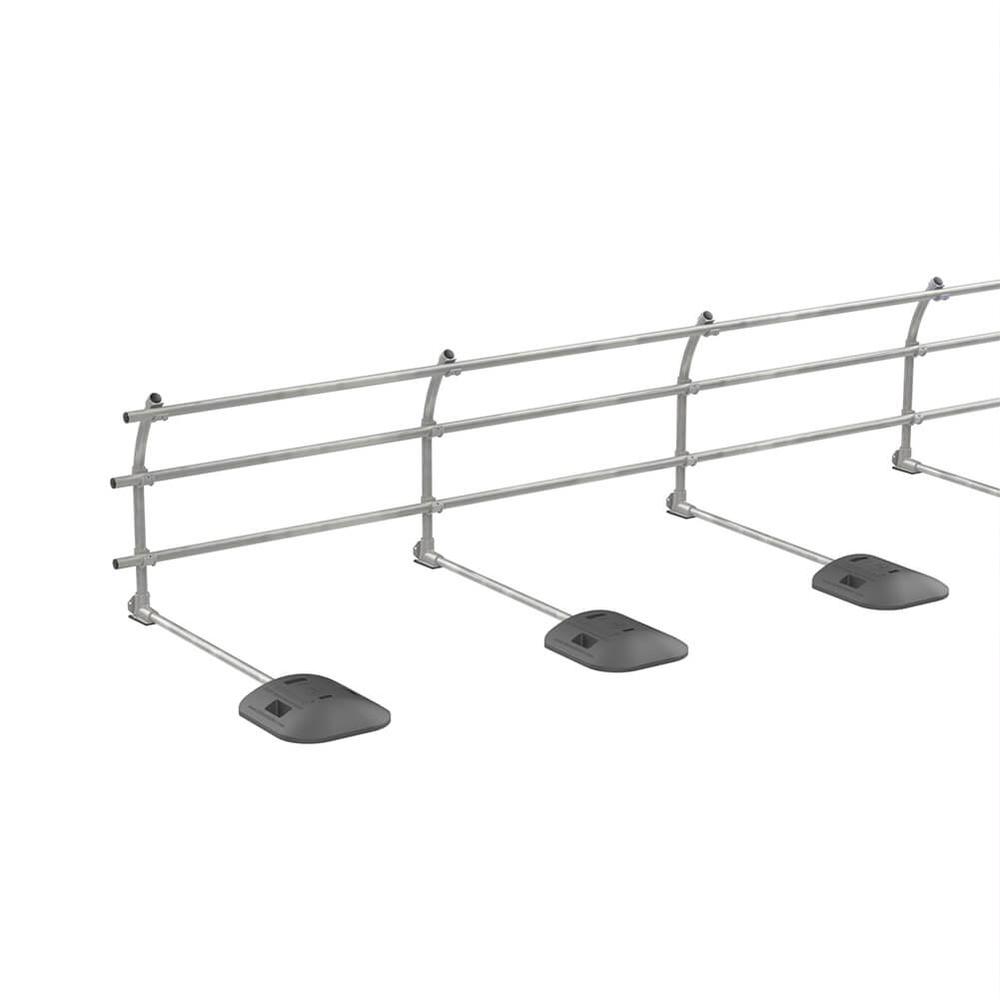
Defender Plus System
Folding & Collapsible Roof Guardrail System (Foldshield):
How do you maintain roof safety without altering building aesthetics?
Install a folding guardrail system (Foldshield) to preserve the building’s architectural sightlines. This variation of our freestanding system manually folds down flat against the roof surface when maintenance work is complete, rendering it entirely invisible from ground level. Foldshield is suitable for installation on flat roofs with up 10° slope, and compatible with asphalt, concrete, mineral felt or PVC sheet covered roofs.
Ideal For: Historic buildings, prestigious architecture, or planning-restricted commercial zones.
Technical Specifications:
• Employs a robust, user-friendly hinge mechanism with a secure locking pin for quick deployment.
• Utilises the same non-penetrative, ~25kg rubber counterweight system as standard freestanding models.
• Supplied in standard Ø48.3mm galvanised steel tube.
• Highly durable, weather-resistant joints ensure smooth operational longevity.
• Designed to meet the requirements of BS 13700 – 2021
• Complies to EN 13374 & 14122
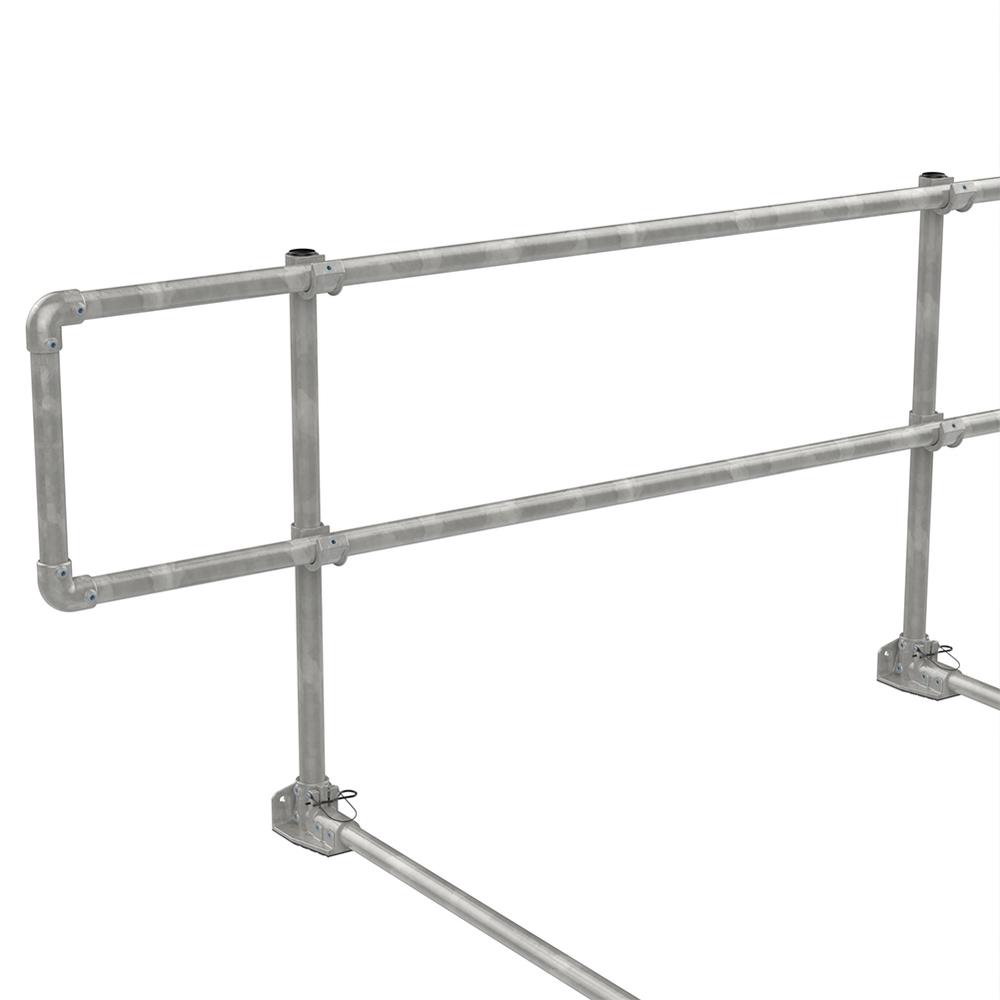
Foldshield System
Metal Roof & Profiled Cladding Guardrail System (Topfix):
What edge protection is best for industrial metal roofs?
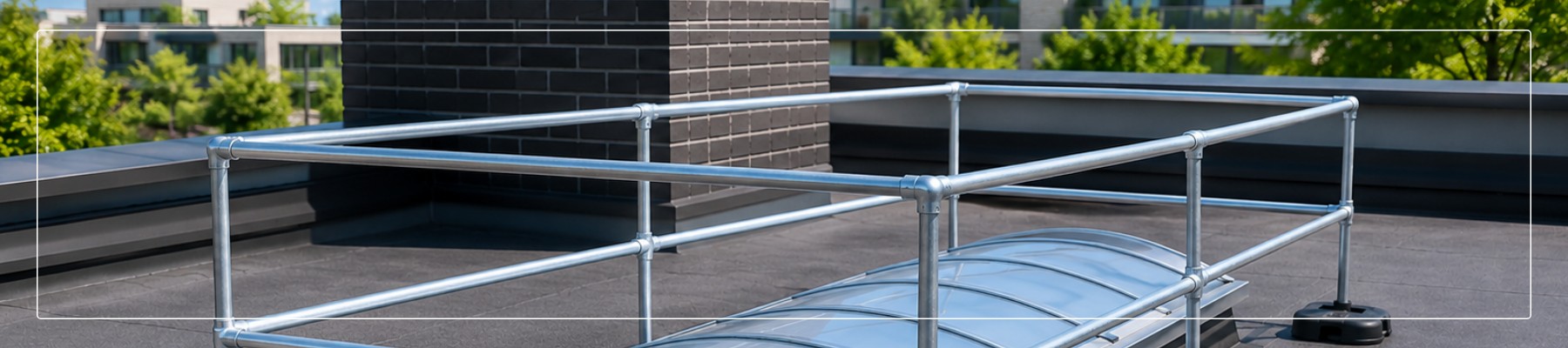
The Topfix system is specifically engineered to fix directly to the metal skin, crown profiles, or standing seams of modern industrial units, providing a lightweight, highly secure safety barrier that distributes loads evenly across the roof panels. Topfix is ideal for pitched roofs, achieving compliant installation on up to 45° roofs.
Ideal For: Industrial warehouses, retail units, composite panels, trapezoidal cladding, and standing seam roofs.
Technical Specifications:
• Standing Seam Options: Completely non-penetrative, utilising specialised clamps that grip the standing seam without piercing the metal.
• Trapezoidal Options: Rivet/screw-fix configurations supplied with high-grade EPDM sealing tape to ensure absolute water-tight integrity.
• Supplied in standard Ø48.3mm galvanised steel tube.
• Complies with the test requirements of BS EN 14122 Part 3 & EN 13374 Class A
• Fixing centres for standing seam roofs: 305, 400 & 500mm
• Fixing centres for trapezoidal profile roof panels: 310, 333, 400 & 500mm
Technical Standards & Compliance Information
All four edge protection systems are rigorously tested to satisfy the following statutory standards:
• BS EN 13374:2013 Class A: Specifies the performance requirements for temporary and permanent edge protection systems subjected to static loads.
• BS EN ISO 14122-3:2016: Standardises permanent access solutions to industrial buildings, walkways, and machinery platforms.
• UK Health & Safety Executive (HSE) Guidelines: Fully aligns with the Work at Height Regulations 2005, which mandate that collective protection systems (like guardrails) must take priority over individual protection systems (like harnesses and lifelines).
FAQs
Yes, roof edge protection is a legal mandate under the Work at Height Regulations 2005 for any roof accessed for maintenance, plant inspection, or cleaning.
The regulations enforce a strict “hierarchy of control” that legally requires building owners and employers to prioritise collective fall protection (such as guardrails) over personal fall protection (such as harnesses and lifelines). Collective systems protect everyone automatically without requiring specialist user training or equipment inspection, eliminating human error at height.
The statutory minimum height for a permanent roof guardrail is 1100mm from the roof’s walking surface. This height is strictly mandated by British and European safety standards BS EN 13374 and BS EN ISO 14122-3. To remain fully compliant, the system must also feature:
- A top principal guardrail at 1100mm.
- An intermediate mid-rail positioned so that the clear open gap between rails does not exceed 470mm.
- A toe-board at the base if an existing structural upstand or parapet of at least 100mm is not present.
Yes, freestanding roof guardrail systems use non-penetrative counterweights to provide full fall protection without puncturing or damaging the roof membrane.
This system is engineered specifically for flat roofs (up to a 3° pitch) finished in single-ply, felt, asphalt, or bitumen where drilling would compromise water-tight integrity. It utilizes heavy, recycled rubber counterweights (approx. 25kg each) split across cantilever arms. The system relies entirely on weight distribution and surface friction to meet statutory load testing requirements, completely eliminating the risk of future water leaks.
A toe-board or kick-plate is legally required if the perimeter edge of the roof does not feature a solid, permanent upstand or parapet wall that is at least 100mm high. According to UK health and safety guidelines, the purpose of a toe-board is two-fold: it stops an operative’s foot from slipping over the edge, and it prevents loose tools, fixings, or maintenance debris from being accidentally kicked off the roof onto people or property below. If your building has an existing coping stone or parapet higher than 100mm, standard handrails can be installed without an additional toe-board / kick-plate profile.
Roof edge protection must be formally inspected, tested, and re-certified at least once every 12 months by a competent person. Annual statutory compliance checks are required under the Provision and Use of Work Equipment Regulations (PUWER) 1998. Because roofs are exposed to extreme weathering, thermal movement, and high winds, the annual inspection verifies:
- Physical structural integrity and torque levels of all slip-on clamp fixings.
- Total absence of severe corrosion or material degradation.
- Correct positioning and security of all counterweights on freestanding models.
- Compliance documentation is updated to shield the building operator from liability.
Fixed systems are a great permanent solution for metal profile and standing seam roofs, whilst free-standing systems require no penetration to the roof membrane and are quicker to install.
The roof edge protection system requires no fixings, welding or drilling, and subsequently no repair to the roof membrane.
Free-standing systems use weighted bases to hold the barrier in place without penetrating the roof surface, making them ideal for membrane or asphalt roofs, leased buildings, or any site where roof integrity must be preserved. Both the Defender and Foldshield systems address this. Topfix with watertight fixings for metal profile roofs.
The best choice will depend on your roof surface, intended use, and how frequently access is needed. Asphalt, coated steel, concrete, standing seam metal, and trapezoidal profile roofs all have different requirements.