Why choose steel railings?
Durability and style
Steel has long been the preferred material for fencing and railings where strength and longevity matter. Here’s why:
Durability – Steel withstands impact, pressure, and harsh weather conditions far better than timber or plastic alternatives. A well-maintained steel fence can last decades.
Security – The inherent strength of steel makes it difficult to cut, bend, or break through.
Low Maintenance – Modern galvanised and powder-coated finishes resist rust and corrosion, reducing upkeep requirements significantly compared to traditional materials.
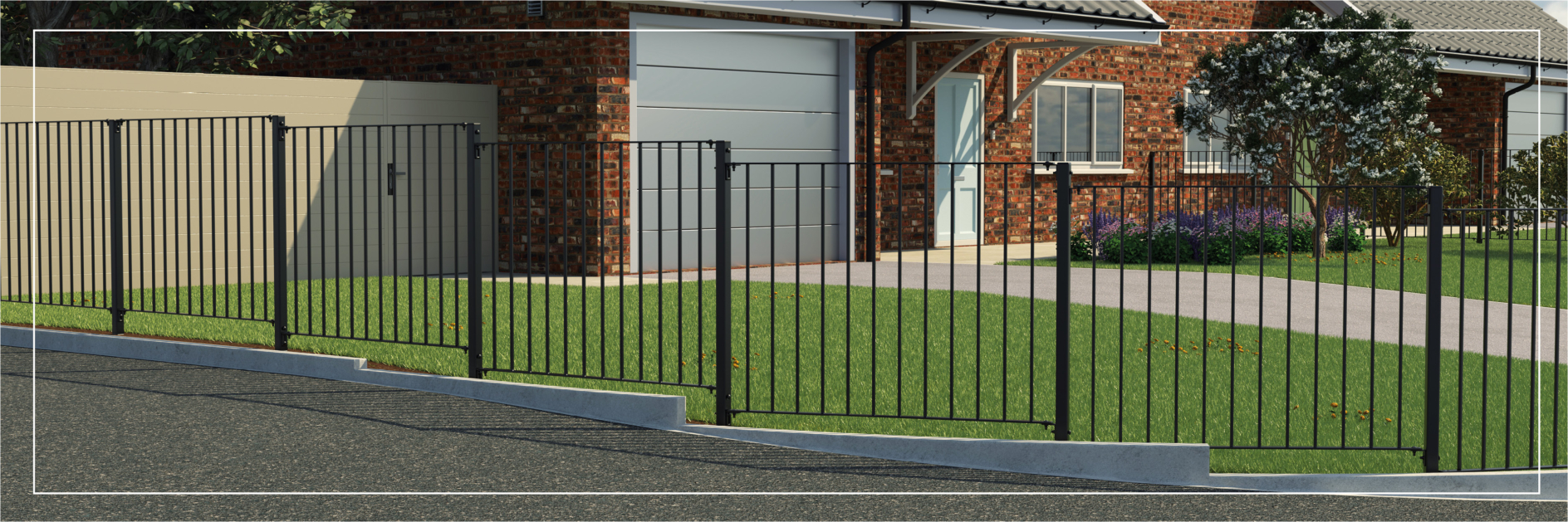
Design Flexibility – Steel can be formed into a wide variety of styles, from simple flat-top railings to decorative designs with finials and scrollwork, suiting both contemporary and heritage settings.
Sustainability – Steel is one of the most recycled materials in the world. Choosing steel fencing supports circular manufacturing practices.
What are the choices when it comes to Steel Railings?
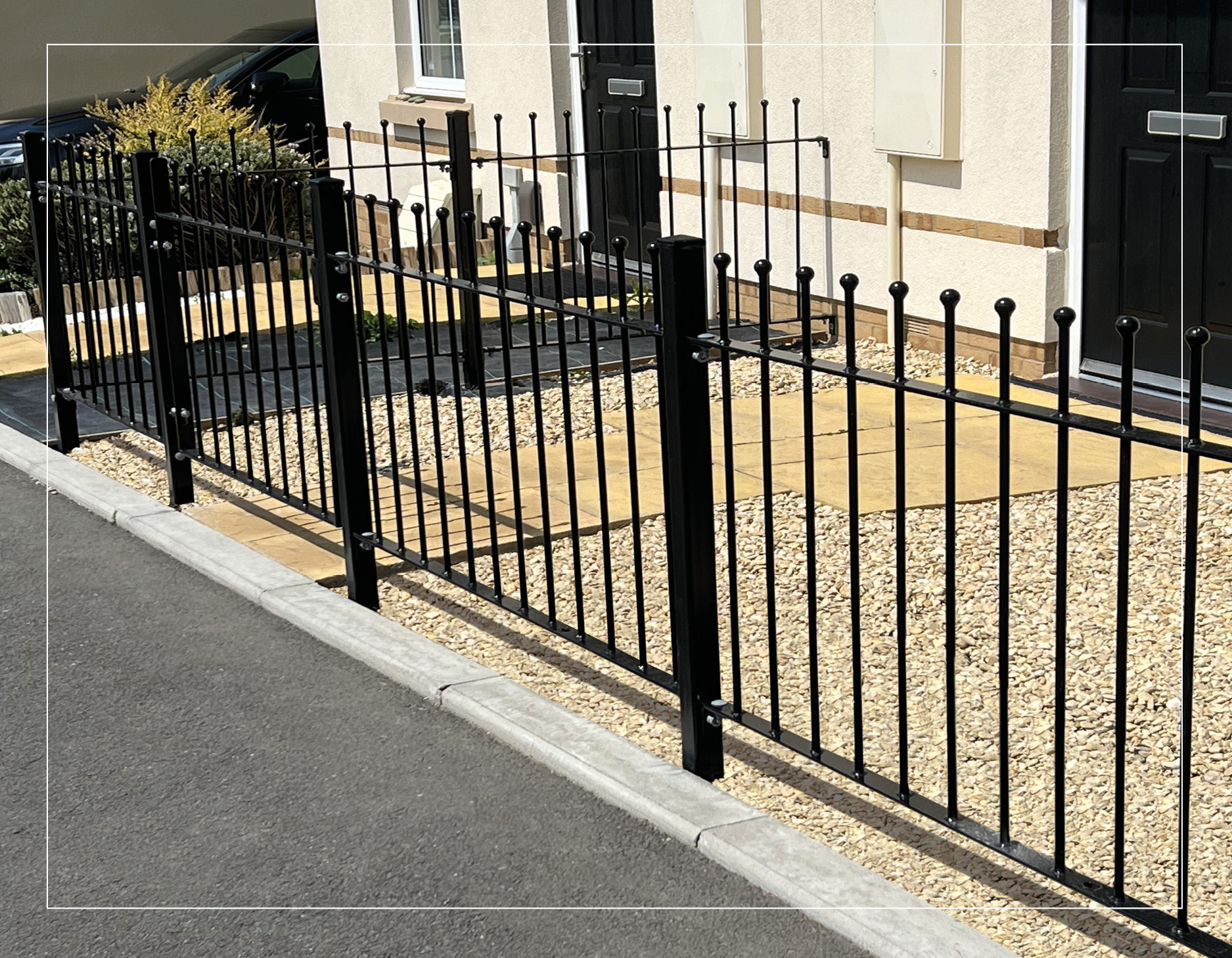
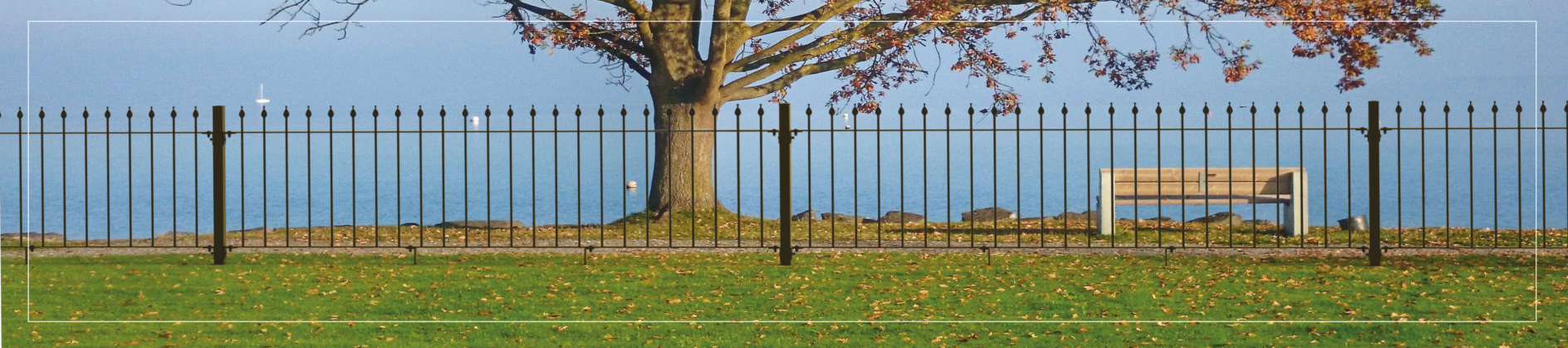
At F.H.Brundle, we have a comprehensive range of steel fencing – from Vertical bar, Fleur De Lis, Forest and Sphere Top styles, to smooth top and wall top railings. The range covers most common fencing requirements without the need to source from multiple suppliers. Available to purchase per metre or individual panels, posts, and accessories, to create your own panels.
For installing steel railings on stairs or slopes, our adjustable sphere top ready-to-install range boasts a raked panel, which is adjustable up to 40 degrees, allowing it to be fitted on gradients with ease.
Matching single and double-leaf gates are available across all the ranges for a complete perimeter installation.
Galvanised or powder coated finish?
Obviously your preferred finish does depend on where you are installing your metal railings. Powder coating over galvanised steel is considered the best option when choosing metal railings because it combines two highly effective forms of protection into one long-lasting system. The galvanising process coats the steel in zinc, which protects it from rust – even if the surface gets damaged – by acting as a sacrificial layer. The powder coating then adds a tough, weather-resistant outer finish that seals the surface from moisture, UV exposure, and general wear, while also providing a smooth, attractive appearance. Together, these layers work in tandem to significantly extend the lifespan of the railings, often doubling the durability compared to using either method alone, while also reducing maintenance and keeping them looking good for many years.
A galvanised finish lends itself to more structural and functional applications where strength, longevity and low maintenance are more important than appearance. It’s also highly cost-effective over time, as it can last decades without needing repainting or significant upkeep.
Steel railings usage
Our Fortitude™ range of steel railings provides a strong, durable, and versatile boundary solution for residential, commercial, and industrial applications. Manufactured from high-quality steel, these railings and gates are designed to deliver long-term performance, reliable security and a clean architectural finish.
Designed as a complete steel railing system, the Fortitude™ range includes all the components required for installation, including panels, posts, fixings and accessories. The railings are available in galvanised steel or a black powder-coated (RAL 9005) finish, with a choice of styles and decorative railheads. Installation options include both bolt-down and concrete-in posts to suit different ground conditions and project requirements.
Available in heights ranging from 500mm to 1800mm, Fortitude™ railings are suitable for everything from decorative wall top railings and low-level boundaries to more secure perimeter fencing. The range includes all essential components for building your railing system, such as panels, posts (with or without fixings), bolts, cleats, and additional accessories.
| Feature Category | Key Benefit | Detail |
|---|---|---|
| Durability & Longevity | Built to Last | Made from durable steel, often galvanised for corrosion resistance. Correctly installed fencing can last for decades (e.g., up to 65 years). |
| Aesthetics | Preserves Views | Creates a simple, strong, and visually attractive, unobtrusive barrier that enhances safety. |
| Design Flexibility | Follows Contours and undulations | The design allows the fencing to follow the natural contours and gradients of the ground, ensuring a consistent line across uneven terrain. |
| Maintenance | Low Maintenance | Requires minimal upkeep over its lifespan, especially when galvanised or powder coated. |
| Installation | Quick, Economical and environmental | Supplied in ready-made panels or components with no welding required on site, making installation fast and cost-effective. |
| Functionality | Effective Barrier | Provides a strong, effective boundary for marking perimeters. |
| Finish Options | Choice of FinIsh | Available in a Galvanised or Powder Coated Black RAL 9005 finish, but can also be powder coated to any RAL colour of your choice. |
Where can Steel Railings be used?
Steel railings are a durable, low-maintenance metal fencing solution that combines strength with a clean, modern aesthetic. Unlike timber, they don’t warp, rot, or require frequent repainting, and when galvanised or powder-coated, they offer excellent resistance to rust and weather damage. This makes them ideal for both residential and commercial use, providing long-lasting security without compromising visibility. Their open design allows light to pass through, helping spaces feel less enclosed while still clearly defining boundaries.
Steel railings are particularly well-suited for front gardens, driveways, parks, and commercial premises where safety and visibility are important. However, they may not be the best choice where complete privacy is required, as they don’t provide a solid barrier like panel fencing. In coastal areas with high salt exposure, additional protective treatments may be necessary to prevent corrosion over time. Overall, steel railings offer a reliable and attractive fencing option where strength, longevity, and appearance are key priorities.
Why is it becoming more popular?
Steel railings are gaining popularity because they offer security, durability, modern aesthetics, and low maintenance in one solution, making them ideal for both residential and commercial properties.
Durability & low maintenance – Galvanised or powder-coated metal resists weather, rot, and pests, lasting decades with minimal upkeep.
Modern appearance & versatility – Metal railings suit both traditional and contemporary designs and can be customised for many property types.
Long-term value & sustainability – Their long lifespan and recyclable materials make them a cost-effective and environmentally friendly fencing option.
How to buy
Now you have more insight into the benefits and use cases of steel fencing, you’ll need to know how to buy this product.
(1) Measure and plan
(2) Style and finish
(3) Select a fixing type
(4) Add a gate (if required)
We’ve simplified the purchasing process by packaging all the components required to complete a fencing section together at a per metre price. Please note that end posts are not included in our metre rates, and one must be purchased separately for each order. Corner posts are also not included and can be purchased as required, dependent on the number of corners. Additionally, you may want to add a gate – this will need to be factored into the run, as will the positioning of the gate. The inclusion of end posts and corner posts is also important – noting that these will add to the measurement of a run.
Once measured and plotted out, you will need to consider the type of fixing – we supply two variants, bolt-down and concrete-in. This will depend on the substrate you’re fixing into. Soft ground may require a concrete-in post for greater stability. Bolt-down fixings provide an ideal solution when installed over existing paving or concrete surfaces.
Finally, you should consider the styling and finish of your steel fencing installation. Available from F.H.Brundle, are the powder-coated black RAL 9005, or galvanised finish, which can be left as is or powder-coated in a RAL colour of your choice.
To help you select the right steel fencing and gates for your needs, why not try our free Fence and Gate Selector tools?
FAQs
All F.H.Brundle solutions are ready-to-install and pre-welded.
Our new ready-to-install adjustable sphere top railing system boasts a raked panel, which is adjustable up to 40 degrees, allowing it to be fitted to almost any staircase, ramp, or sloped pathway.
Available with concrete-in posts, our adjustable sphere top fencing panels come supplied in a contemporary PPC black gloss. No matter your fencing requirements, our contemporary adjustable sphere top range is the ideal solution for gradients.
Steel is exceptionally strong, making it ideal for high-traffic areas, staircases, and balconies where structural integrity matters. It resists impact, warping, and cracking far better than wood or vinyl. With proper treatment (galvanising or powder coating), steel railings can last decades with minimal maintenance. They won’t rot, splinter, or become brittle over time.
Unlike wood, steel doesn’t need regular sanding, staining, or sealing. A periodic wipe-down and occasional touch-up of the finish is usually all that’s needed.
Steel is non-combustible, which can be an important safety and building code consideration.
You can fix steel railings to pretty much any surface or substrate – paving is no exception. But it will depend on the paving. If the paving is a fixed substrate like concrete or stone, then a bolt-down fixing can be employed. If the paving is not a fixed substrate, e.g. paving slabs or porcelain tiles, then it is advisable to either use a concrete-in fixing solution, and cutting the tiles or slabs to allow for the posts.
Steel railings when used as intended, do not need to conform to any British building regulations. Railings with vertical bars are generally considered low-climbability and therefore favourable from a compliance perspective.
For any project requiring building control sign-off, it’s worth confirming with your local authority or a building inspector, as interpretation can vary slightly.
Galvanised Steel Railings
- Galvanised steel has a zinc coating that protects against rust. To keep it in good shape:
- Wash regularly with warm water and a mild detergent (dish soap works well)
- Use a soft cloth or sponge – avoid abrasive pads that scratch the zinc layer
- Rinse thoroughly and dry to prevent water spotting
- In coastal or high-salt environments, clean more frequently as salt accelerates zinc deterioration
Powder Coated Steel Railings
- Powder coating is a durable paint-like finish baked onto the steel. It’s tough but can chip or fade if neglected.
- Wipe down with warm soapy water and a soft cloth 2–4 times a year (more often near the sea or roads)
- Avoid harsh chemicals, solvents, or bleach – these break down the coating
- Don’t use wire brushes or abrasive cleaners
- Check for chips, cracks, or scratches regularly – exposed steel underneath will rust quickly
- Touch up any damaged areas promptly with a matching powder coat touch-up paint or a compatible metal primer and topcoat
- In winter, rinse off road salt and grit as soon as possible
General Tips for Both
- Avoid pressure washing at close range – it can force water into joints and strip protective coatings
- In very harsh environments (coastal, industrial), consider a professional re-galvanise or recoat every 10–15 years
With regular cleaning and prompt attention to any damage, both types of railing should last decades.
Our ready-to-install steel railings offer a variety of long-lasting, easy-to-install railing solutions, by packaging all the components required to complete a railing section, packaged together at a per metre price, with the option of either bolt-down or concrete-in posts.
Please note: End posts are not included in our metre rates and one must be purchased separately for each order. Corner posts are also not included and can be purchased as required, dependent on the number of corners.
Typical lifespan 20-50+ years is common in most environments.
Why do they last so long?
Galvanising (zinc coating) protects the steel from rust, even if the surface gets scratched.
Powder coating adds a tough outer barrier that shields against moisture and UV, slowing down the wear of the zinc layer underneath.