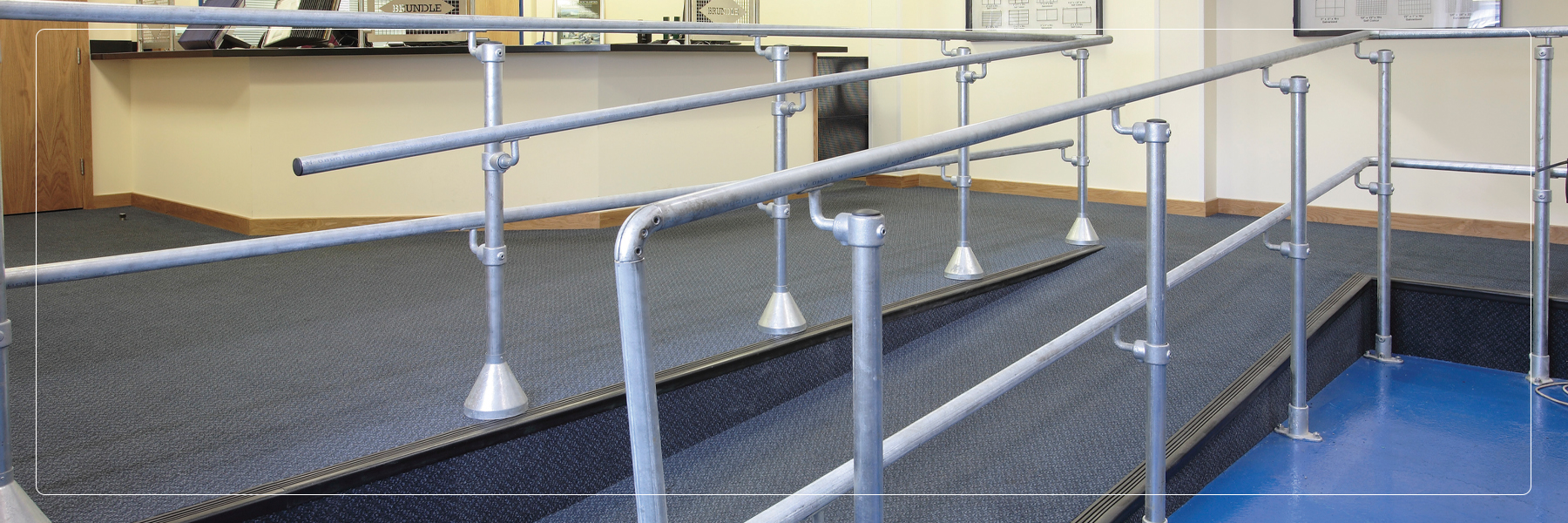
Why Choose DDA & Accessible Handrail Systems?
Accessible handrail systems for construction, civil engineering, transportation and architectural applications
Provide practical, accessible support on stairs, ramps, walkways and other access routes with DDA handrails and fittings from F.H.Brundle.
Our range is designed to help contractors, fabricators, engineers, architects and specifiers create smooth, continuous and easy-to-grip handrail systems for a wide variety of public, commercial, industrial and architectural environments.
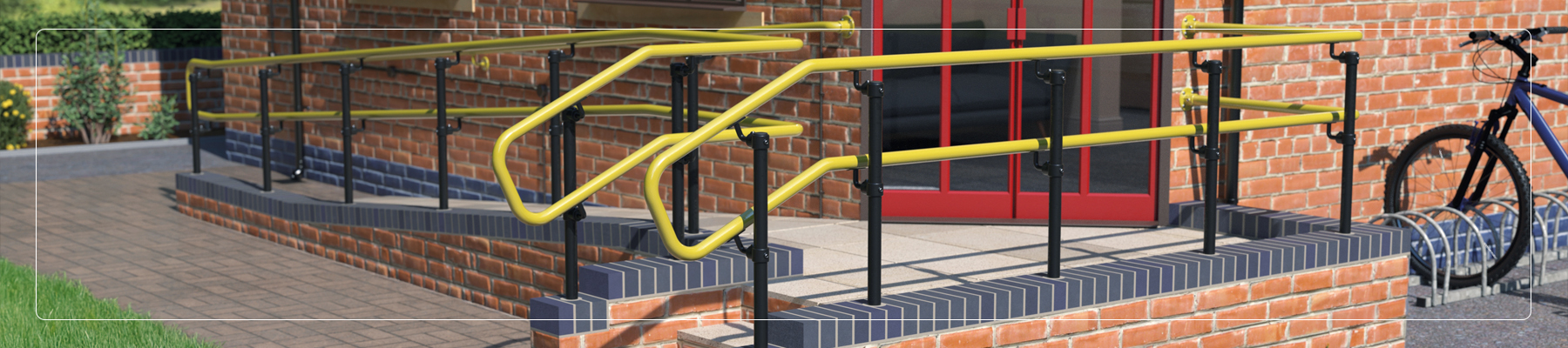
The range includes Stargard Flex Bendy Steel DDA handrail, pre-made posts, handrail fittings and fixings, providing the components needed to create a coordinated accessible handrail installation. Stargard Flex Bendy Steel is designed to be manipulated by hand to create bends and angles and is available in Signal Yellow (RAL 1003) and Anthracite Grey (RAL 7016).
Shop DDA handrail components online or contact F.H.Brundle for help with your requirements.
What is DDA Handrail?
A DDA handrail is a handrail designed to provide accessible support for people using stairs, ramps and other pedestrian access routes.
The term “DDA handrail” is still widely used when searching for accessible handrail products, although the Disability Discrimination Act 1995 (DDA) has been replaced by the Equality Act 2010 in Great Britain.
For current building work in England, accessibility requirements are addressed through legislation and guidance including Approved Document M – Access to and use of buildings, while Approved Document K covers protection from falling, collision and impact, including guidance relating to stairs, ramps, guarding and handrails.
For this reason, terms such as accessible handrail, disability access handrail and DDA handrail may all be used when specifying or searching for suitable products.
DDA Handrails from F.H.Brundle
F.H.Brundle’s DDA handrail range provides components for creating smooth, accessible handrail systems.
The range currently includes:
Stargard Flex Bendy Steel DDA Handrail
A flexible handrail system designed to be manipulated by hand to create bends and angles. It is available in Signal Yellow (RAL 1003) and Anthracite Grey (RAL 7016).
Pre-made DDA handrail posts
Ready-made posts provide a convenient way to create a complete handrail installation without fabricating every post individually.
DDA handrail fittings
A selection of fittings allows handrail sections to be joined, turned, supported and terminated according to the required layout.
DDA handrail fixings
Dedicated fixing products complete the installation and allow the handrail system to be secured to the appropriate supporting structure.
Shop the complete DDA handrail range.
Applications for DDA Handrail
Construction
Accessible circulation is an important consideration in the design and construction of commercial and public buildings.
DDA handrails can be incorporated into access routes including:
• Stairs
• Ramps
• Walkways
• Building entrances
• External access routes
• Public buildings
• Commercial developments
• Schools and educational facilities
• Healthcare environments
• Leisure facilities
• Industrial and workplace buildings
The handrail should be designed as part of the complete access route, taking into account the route geometry, handrail position, continuity, clearances, fixing arrangements and applicable regulations.
F.H.Brundle supplies the handrail, posts, fittings and fixings needed to create a coordinated system.
Civil Engineering
Civil engineering projects can involve extensive pedestrian infrastructure, access routes and changes in level.
Accessible handrails can be considered for:
• Bridges and pedestrian structures
• Footpaths
• Ramps
• Public-realm improvements
• Infrastructure projects
• Access platforms
• Retaining structures
• Industrial facilities
• Maintenance areas
• External stairs and walkways
For civil engineering applications, product selection should consider the environment, expected loading, fixing substrate, exposure to weather and the specific requirements of the project.
Where a handrail forms part of a wider structure or safety-critical installation, the complete system should be designed and assessed by the appropriate competent professional.
Transportation
Transportation infrastructure needs to accommodate people with different mobility requirements while providing clear and practical pedestrian routes.
DDA and accessible handrails can be considered for applications such as:
• Railway stations
• Transport interchanges
• Bus stations
• Airports
• Pedestrian bridges
• Ramps and access routes
• Platforms
• Passenger facilities
• Transport maintenance facilities
For railway projects in Great Britain, accessibility requirements may also be affected by project-specific railway standards and specifications. The Department for Transport’s current accessibility National Technical Specification Notice applies to relevant rail projects seeking authorisation to place new, upgraded or renewed railway equipment into service.
The correct handrail specification should therefore be established from the project requirements rather than assuming that a generic “DDA handrail” will automatically satisfy every transportation application.
Architectural Applications
Accessible handrails can be functional and visually integrated into an architectural scheme.
For architects and designers, F.H.Brundle’s range provides options for creating handrails that support accessibility while complementing the surrounding building or landscape.
Suitable applications can include:
• Commercial buildings
• Offices
• Retail environments
• Public buildings
• Residential developments
• Schools and universities
• Healthcare buildings
• Leisure facilities
• Museums and visitor attractions
• Landscape architecture
• Public spaces
The Stargard Flex Bendy Steel range is available in Signal Yellow and Anthracite Grey, providing options for projects where the handrail needs to be visually prominent or coordinated with the surrounding design.
Overview of Applications for DDA Handrail
| Application Sector | Typical Applications | Key Considerations | F.H. Brundle System Benefits |
|---|---|---|---|
| Construction | Stairs, ramps, walkways, entrances, external access routes and public buildings | Route geometry, handrail position, continuity, clearances, fixings and applicable regulations | Handrail, posts, fittings and fixings can be specified as a coordinated system |
| Civil engineering | Bridges, footpaths, ramps, access platforms, retaining structures and infrastructure | Weather exposure, loading, fixing substrate, environment and project-specific requirements | Components suitable for creating handrail systems across a range of external applications |
| Transportation | Railway stations, transport interchanges, airports, pedestrian bridges, platforms and ramps | Accessibility requirements, pedestrian flow, environment and relevant transport standards | Options for accessible pedestrian routes and infrastructure applications |
| Architecture | Offices, retail, public buildings, residential developments, schools, healthcare and leisure facilities | Accessibility, aesthetics, material selection, colour and integration with the building | Handrail options designed to combine accessibility with architectural appearance |
| Landscape & public realm | Parks, public spaces, external walkways, landscaped areas and visitor attractions | External exposure, route design, visual prominence and integration with surroundings | Suitable finishes and configurations for visible external handrail installations |
| Industrial & workplace | Industrial buildings, maintenance areas, access platforms, stairs and walkways | Durability, environment, loading and fixing substrate | Components for creating practical access and pedestrian handrail systems |
Why Choose a Smooth Continuous Handrail?
A well-designed accessible handrail should provide a user with a dependable surface to grip and follow along an access route.
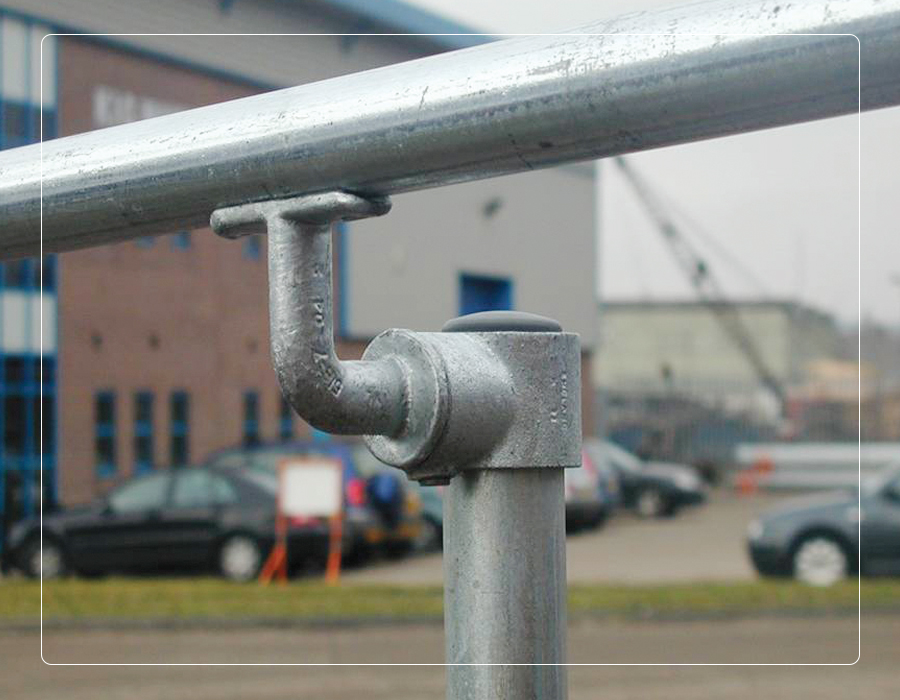
F.H.Brundle’s DDA handrail fittings are designed to support a system where the top of the handrail remains free from obstructions, with fittings supporting the tube from underneath. This creates a smooth top surface that can be easier for users to grip and move their hand along.
This approach is particularly useful when designing handrails for:
• Stairs
• Ramps
• Long access routes
• Public buildings
• Commercial premises
• Transportation facilities
• External pedestrian routes
The final handrail arrangement should always be checked against the requirements applicable to the specific building or infrastructure project.
| Feature | Benefit | Why it Matters |
|---|---|---|
| Smooth top surface | Provides a consistent surface for users to grip | Helps users maintain contact with the handrail along the route |
| Under-mounted fittings | Fittings support the tube from underneath | Helps keep the top of the handrail free from obstructions |
| Continuous arrangement | Creates a consistent handrail along stairs, ramps and walkways | Supports predictable movement along an access route |
| Clear grip area | Minimises interruptions to the handrail surface | Can make the handrail easier to follow and use |
| Flexible configuration | Components can be combined to create different layouts | Allows systems to accommodate different route geometries |
| Architectural finishes | Handrail can complement or contrast with the surrounding environment | Useful where accessibility and visual design need to work together |
| System approach | Handrail, posts, fittings and fixings can be specified together | Helps installers and specifiers coordinate the complete installation |
Smooth Continuous Handrail: Key Benefits
| For Users | For Installers | For Architects & Specifiers |
|---|---|---|
| Consistent surface to grip | Coordinated components | Clean architectural appearance |
| Easier to follow along a route | Compatible fittings and fixings | Accessibility integrated into the design |
| Reduced interruption from fittings | Flexible configurations | Choice of finishes |
| Suitable for stairs and ramps | Simplified system selection | Suitable for a range of building and landscape applications |
Stargard Flex Bendy Steel DDA Handrail
Stargard Flex Bendy Steel is designed with flexibility in mind and can be manipulated by hand to suit different bends and angles. This makes it useful where an access route requires changes in direction rather than a simple straight handrail run.
The system is suitable for use with DDA handrail brackets and posts. F.H.Brundle currently offers the system in:
• Signal Yellow – RAL 1003
• Anthracite Grey – RAL 7016
The fittings are designed around the system’s tube construction, with F.H.Brundle noting that Ø42.4mm fittings contain a Ø33.7mm galvanised tube core, while Ø48.3mm fittings contain a Ø42.4mm galvanised tube core.
DDA Handrail Fittings & Components
A successful accessible handrail installation requires the right combination of components.
Handrail tube
The handrail forms the continuous gripping surface. Choose the appropriate Stargard Flex or compatible handrail product for the required installation.
Posts
Posts provide the structural support for freestanding handrails. F.H.Brundle offers pre-made posts specifically for DDA handrail applications.
Brackets and fittings
DDA fittings connect the handrail to posts or supporting structures while helping maintain a smooth upper gripping surface.
Fixings
The correct fixings depend on the supporting substrate and installation method. Select fixings appropriate to the structure and project requirements.
Returns and terminations
Where required, handrail ends should be configured and terminated appropriately to minimise snagging and maintain a safe, accessible route.
| Component | Purpose | Application |
|---|---|---|
| Handrail tube | Provides the continuous gripping surface | Stairs, ramps, walkways and access routes |
| Handrail fittings | Connect and support sections of handrail | Corners, changes of direction and terminations |
| Posts | Support the handrail system | Where intermediate or structural support is required |
| Fixings | Secure components to the supporting structure | Walls, floors, posts and other suitable substrates |
| Finishes | Provide the desired visual appearance | Architectural, public-realm and industrial applications |
How to Specify a DDA Handrail
Choosing an accessible handrail is about more than selecting a tube diameter. Consider the complete route and installation.
1. Identify the access route
Determine whether the handrail is required for a stair, ramp, walkway, landing or another access route.
2. Measure the handrail run
Establish the overall length and identify any changes in direction, intermediate supports and termination points.
3. Determine whether the handrail is wall-mounted or freestanding
A wall-mounted handrail and a freestanding handrail will require different supporting components.
4. Select the appropriate handrail system
For routes requiring curves or changes in direction, consider whether Stargard Flex Bendy Steel is suitable.
5. Select posts and fittings
Choose compatible posts, brackets, connectors, bends and other components required to complete the layout.
6. Select suitable fixings
Fixings should be compatible with both the handrail components and the supporting substrate.
7. Check accessibility requirements
Review the relevant building regulations, standards and project specification before ordering and installation.
DDA Applications by Project Type
| Project Type | Where DDA Handrails May be Used | What to Consider |
|---|---|---|
| Stairs | Internal and external stairways | Handrail continuity, height, clearances, ends and fixing arrangements |
| Ramps | Accessible ramps and changes in level | Route gradient, handrail position, continuity and user movement |
| Walkways | Pedestrian routes and circulation areas | Route geometry, accessibility and uninterrupted handrail provision |
| Building entrances | Steps, ramps and entrance approaches | Integration with the building and surrounding access route |
| Bridges | Pedestrian bridges and elevated routes | Structure, loading, environmental exposure and fixing substrate |
| Transport facilities | Stations, platforms, interchanges and passenger routes | Project-specific accessibility and transportation standards |
| Healthcare | Hospitals, care facilities and healthcare buildings | Accessibility, ease of grip, durability and continuous support |
| Education | Schools, colleges and universities | Accessibility, durability and suitability for high-use environments |
| Leisure | Sports centres, visitor attractions and recreational facilities | High pedestrian use, accessibility and architectural integration |
| Industrial | Workplace stairs, platforms and maintenance routes | Environment, loading, durability and fixing arrangements |
| Public realm | Footpaths, parks and public spaces | Weather exposure, visibility, accessibility and landscape integration |
Choosing the Right System for Your Project
| Project Requirement | What to Consider |
|---|---|
| Accessibility | Applicable accessibility requirements and standards for the project |
| Route geometry | Straight runs, corners, ramps, stairs and changes in direction |
| Handrail continuity | Whether the handrail can provide a consistent gripping surface |
| Clearances | Space around the handrail and between the handrail and adjacent structures |
| Fixing substrate | Wall, floor, structural steelwork or other supporting surface |
| Environment | Internal, external, exposed, corrosive or high-use environment |
| Loading | Expected loads and forces applicable to the completed installation |
| Material | Steel or other specified handrail material |
| Finish | Colour, corrosion protection and architectural appearance |
| Installation | Available fittings, posts, fixings and fabrication requirements |
| Regulatory requirements | Building, accessibility, transport or project-specific standards |
| Maintenance | Cleaning, inspection and long-term durability requirements |
DDA Handrail Height and Accessibility Requirements
Handrail height is an important consideration when designing an accessible route.
The precise requirements depend on the type of building, access route and applicable regulations.
For example, F.H.Brundle’s guidance referencing Part M and accessible access routes states that, where handrails are provided on ramped or stepped access routes, the upper handrail is generally positioned between 900mm and 1000mm above the pitch line of a flight, with the relevant requirements for landings and other situations also needing consideration.
Approved Document M provides guidance on access to and use of buildings in England, while Approved Document K includes requirements and guidance relating to protection from falling and the design of stairs, ramps and guarding.
Do not specify handrail height from a generic product page alone. Check the current regulations and project specification applicable to the installation.
DDA Handrails and the Equality Act 2010
The phrase “DDA handrail” remains widely used in the construction industry, but it is important to understand the terminology.
The Disability Discrimination Act was replaced by the Equality Act 2010 in Great Britain. The Equality Act brought together and replaced previous anti-discrimination legislation, including the DDA.
F.H.Brundle’s current DDA handrail page refers to the Equality Act 2010 and explains that reasonable adjustments may be required in commercial and public buildings to overcome physical barriers affecting disabled access.
For building projects in England, Approved Document M provides guidance on access to and use of buildings. It is statutory guidance supporting compliance with the Building Regulations, rather than a product certification scheme.
This distinction matters when specifying an accessible handrail: a product being marketed as a “DDA handrail” does not, by itself, mean that every installation will comply with every applicable requirement.
DDA Handrails for Internal and External Applications
F.H.Brundle’s DDA handrail range can be considered for both internal and external access routes, subject to the suitability of the complete system and finish for the environment.
When specifying an external handrail, consider:
• Weather exposure
• Corrosion resistance
• Surface finish
• Fixing substrate
• Temperature
• Impact risk
• Drainage
• Cleaning and maintenance
• Expected pedestrian traffic
For demanding environments, the appropriate material, coating and fixing system should be selected based on the project conditions.
F.H.Brundle also offers a wider range of galvanised, stainless steel, aluminium, powder-coated steel and GRP handrail products, providing alternatives where a different material or performance specification is required.
Why Buy DDA Handrails from F.H.Brundle?
Complete handrail components
Whether you’re specifying an accessible entrance for a commercial building, installing handrails on a public staircase, developing a transportation access route or designing an architectural railing system, F.H.Brundle provides a range of DDA handrails, fittings, posts and fixings for professional applications.
From flexible Stargard Flex Bendy Steel to pre-made posts and dedicated fittings, the range provides components for creating practical accessible handrail systems.
Flexible handrail options
Stargard Flex Bendy Steel can be manually manipulated to create different bends and angles, providing flexibility when designing access routes.
Specialist handrail expertise
DDA handrails are part of F.H.Brundle’s wider handrailing and balustrade offering, which includes tubular handrails, handrail standards, brackets, capping, tube clamps, mezzanine handrails and complete balustrade systems.
Nationwide product supply
F.H.Brundle supplies trade professionals and contractors across the UK, with a broad catalogue of metal, handrailing, fencing, mesh, steel and associated products.
Need help choosing components? Contact F.H.Brundle’s sales team for product guidance.
Audience-Specific Considerations
| Audience | Primary Concern | Key information to provide |
|---|---|---|
| Homeowners | Safe and practical access | Where handrails can be used and the importance of correct installation |
| Installers | Correct system selection and installation | Components, fittings, fixings, route geometry and substrate |
| Architects | Accessibility and aesthetics | Finishes, continuous handrail design and architectural integration |
| Specifiers | Compliance and performance | Product characteristics, project requirements and applicable standards |
| Contractors | Efficient installation | Coordinated components and suitable fixing arrangements |
| Civil engineers | Structural and environmental suitability | Loading, substrate, exposure and project-specific requirements |
| Transport professionals | Accessibility and infrastructure standards | Relevant transport requirements and project-specific specifications |
Complete Your Accessible Handrail Project
F.H.Brundle can supply more than the handrail itself.
Depending on the project, you can also explore:
• Handrail brackets
• Handrail standards
• Galvanised handrail
• Stainless steel handrail
• GRP handrail
• Handrail tube and bends
• Handrail fixings
• Kick plates
• Mezzanine handrails
• Pallet gates
• Balustrade systems
• Steel sections
• Fixings and fastenings
• Industrial flooring and stair treads
This allows contractors, fabricators and specifiers to source complementary products alongside their DDA handrail requirements.
FAQs
A DDA handrail is a handrail designed to provide accessible support on routes such as stairs, ramps and walkways. The term is still commonly used in the construction industry, although the Disability Discrimination Act has been replaced by the Equality Act 2010 in Great Britain.
The requirement for handrails depends on the building, access route and circumstances. In England, accessibility requirements are addressed through legislation and building regulations, including Approved Document M, while Approved Document K covers protection from falling and related matters.
A handrail should therefore be specified according to the requirements of the particular project rather than assuming that every stair or ramp has identical requirements.
An accessible handrail should provide a suitable, secure gripping surface and be positioned so that it can be comfortably used along the access route. Continuity, height, clearance, extensions, terminations and the surrounding environment also need to be considered.
The appropriate handrail diameter depends on the system and applicable requirements. F.H.Brundle’s Pro-Railing guidance identifies 42.4mm outside diameter round tube as a standard size for a graspable DDA handrail, with other diameters available for different applications.
Always check the applicable regulations and product specification before selecting the tube size.
The required handrail height depends on the type of access route and building. F.H.Brundle’s guidance referencing Part M gives a typical range of 900–1000mm above the pitch line for the upper handrail on ramped or stepped accessible routes, while different measurements apply to landings and other situations.
Always check the current applicable guidance for the specific project.
Stargard Flex Bendy Steel is a flexible handrail system that can be manipulated by hand to create bends and angles. It is designed for use with DDA handrail brackets and posts and is available in Signal Yellow and Anthracite Grey.
Yes. DDA handrails can be used on stairways to provide support for people using the access route. The handrail arrangement should be designed according to the applicable building regulations and project specification.
They can be suitable for public buildings where the selected system and installation meet the requirements of the project. Applications can include entrances, stairs, ramps, walkways and other accessible routes.
They can be considered for transportation infrastructure such as stations, interchanges, pedestrian bridges, ramps and access routes. Transportation projects can have additional standards and specifications, so the complete installation must be assessed against the relevant requirements. For applicable rail projects, the Department for Transport publishes a current accessibility NTSN.
Start by identifying the handrail type and diameter, the mounting arrangement, the number of posts, changes in direction and the supporting substrate. Then select compatible fittings, posts and fixings for the complete layout.
No. “DDA compliant” is commonly used as a product-search term, but the DDA has been replaced by the Equality Act 2010. Building regulations and other project requirements determine whether a particular installation is appropriate. In England, Approved Documents M and K provide relevant guidance for access and protection from falling.
The complete handrail system, its installation and the surrounding access route should be assessed against the requirements applicable to the project.